Top Minnesota corrections official questions when federal immigration agencies will draw down forces

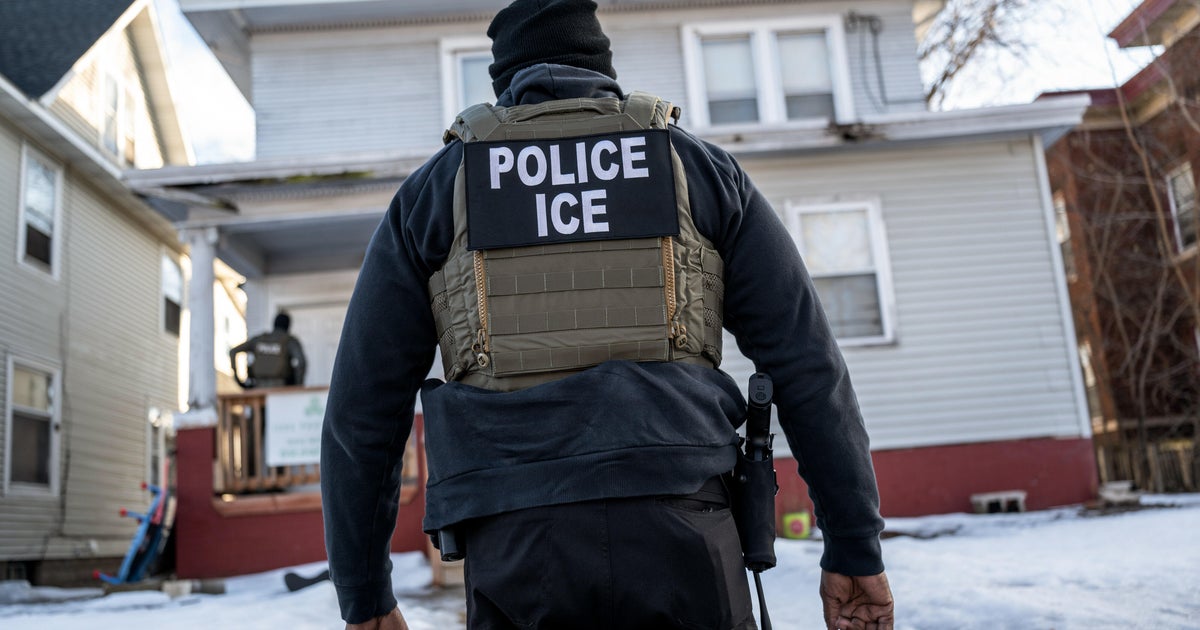
In the week-and-a-half since federal immigration agents fatally shot a man in Minnesota, the state’s top corrections official told CBS News there have been “conversations” with the federal government, including with people who report to White House border czar Tom Homan.
But Department of Corrections Commissioner Paul Schnell said details on a possible deescalation in the state — which has been the subject of a monthslong immigration crackdown — remain “sketchy,” with no signs of a drawdown of federal forces yet.
Homan said last week he is preparing to reduce the thousands of ICE and Border Patrol agents in the Minneapolis area at some point, but the exact timeline is not clear.
Schnell also said he remains “deeply concerned” about tactics that are still being reported, including agents appearing at bus stops and entering apartment buildings without a clear, targeted list of priorities.
“We don’t want roving bands of agents going into apartment buildings and asking people for their papers,” Schnell said. “We want a focused, targeted operation aimed at people who actually pose a risk to public safety.”
How is the state cooperating with ICE?
The immigration operation in the Minneapolis area — known as Operation Metro Surge — began in early December and has led to more than 3,000 arrests. The operation has drawn stiff criticism from state and local officials over agents’ tactics, which intensified after 37-year-old Alex Pretti was shot by a Border Patrol agent and a Customs and Border Protection officer on Jan. 24. Weeks earlier, Renee Nicole Good was shot by an ICE agent in Minneapolis.
The Trump administration, meanwhile, has demanded more cooperation from the state of Minnesota and the city of Minneapolis in detaining and turning over people accused of being in the U.S. illegally, with Homan suggesting the timing of a federal drawdown could be “dependent upon cooperation.” The administration has accused the state of not honoring detainer requests from ICE, which Schnell has strongly denied in the past.
Federal immigration “detainers” are administrative requests — not criminal warrants — that ICE sends to a state prison or county jail asking to be notified before a person is released and, in some cases, asking the facility to hold that person briefly so federal agents can take custody.
Because detainers are not signed by a judge, many states — including Minnesota — treat them with some caution. Local officials in Minnesota say holding someone past their scheduled release without a court order can raise constitutional concerns and expose local agencies to legal liability. Historically, Minnesota’s state practice has been to notify and coordinate ICE when a non-citizen is released from custody, without extending their detention.
Schnell said the state carried out a review of its prison population and found that 380 non-U.S. citizens are currently in Minnesota custody statewide. Of those, he added, 270 had active ICE detainers, leaving 110 people that the federal government could have placed detainers on but did not, even after state authorities notified the Department of Homeland Security.
“We notified them. They did not issue detainers,” Schnell said emphatically.
He argued the lack of action by DHS undercut federal claims that Minnesota is blocking access to its prisons.
“When they say, ‘Let us into your prisons,’ our response is, ‘we are notifying you — and you’re not even requesting everyone you could,'” Schnell said. “Collaboration, conversations, working together to know who these targets are — that does make good sense, and that has not happened to date.”
CBS News has reached out to DHS for comment.
Federal officials, including Homan, have repeatedly demanded of state and local leaders: “Let us into your prisons, let us into your jails.”
Schnell said that framing misses a legal line Minnesota will not cross.
“The answer to that is no. We can’t. We won’t.” Schnell said. “Minnesota has a justice interest; victims have a justice interest.”
Minnesota cannot release people early from state sentences to federal custody because the state has its own obligations to victims and courts, Schnell said. The state’s position is that ICE can take custody after a sentence is completed, but it cannot override a state court judgment.
What Minnesota wants from the federal government
Schnell outlined two demands for the federal government.
Minnesota Gov. Tim Walz has asked for a “dramatic and sizable” reduction in federal personnel, arguing there is “no justification” for the scale of the deployment given the actual number of people in Minnesota who could be subject to removal. A week after requesting a plan, Schnell said the state still has no real details.
“We have no idea what the drawdown looks like,” Schnell said. “We’ve been told plans are being developed — but the details remain sketchy.”
Homan — who arrived in Minneapolis following Pretti’s death — told reporters last week that officials were working on a drawdown plan, but he said it’s dependent on federal authorities getting access to jails in the state. He added: “I’m staying till the problem is gone.”
Second, the state is demanding a credible, transparent joint investigation into the deaths of Pretti and Good, with state access to evidence in both cases. State authorities have alleged the federal government has blocked them from accessing evidence on the two fatal shootings.
“A credible investigation means a full review of evidence,” Schnell stated, including interviews with everyone involved, coordination between federal and state investigators, and consideration of both criminal law and civil rights law.
Asked whether he is confident in the investigations now, Schnell said plainly: “Where it sits today? No. I think there is good reason for us to be concerned.”
The FBI took the lead in investigating Pretti’s death last week, a shift after DHS’s Homeland Security Investigations division was previously tasked with handling the investigation. Deputy Attorney General Todd Blanche said last week the Justice Department’s Civil Rights Division is also looking into the incident, calling the division “the best experts in the world at this” and saying a federal probe is “what we would always do in circumstances like this.”
He said the decision to move the Pretti case to the FBI was “a good move,” but added that the lack of detail from federal authorities has been a problem from day one.
Fear of collateral damage to public safety
Schnell echoed concerns raised by local sheriffs and police chiefs throughout Minnesota that criminals could exploit the chaos that has arisen during the federal surge.
But he added that the real risk is broader: distrust of law enforcement, fear in immigrant communities, disruption of normal policing and erosion of government credibility.
“Governmental trust is fundamental,” he said. “When we don’t have it, we have a problem.”
Schnell commended Minnesota law enforcement for trying to manage a difficult situation responsibly — protecting the public while preventing confrontations from becoming explosive — but added that restoring trust will take time.
“We are not out of the woods yet. We have work to do.”
Recent conversations with federal government officials have begun to refocus federal officials on “professional, constitutional policing” and accountability, according to the commissioner.
“Accountability has to be on the government as well as the public,” he said. “Misinformation fuels mistrust — and mistrust is our biggest problem right now.”