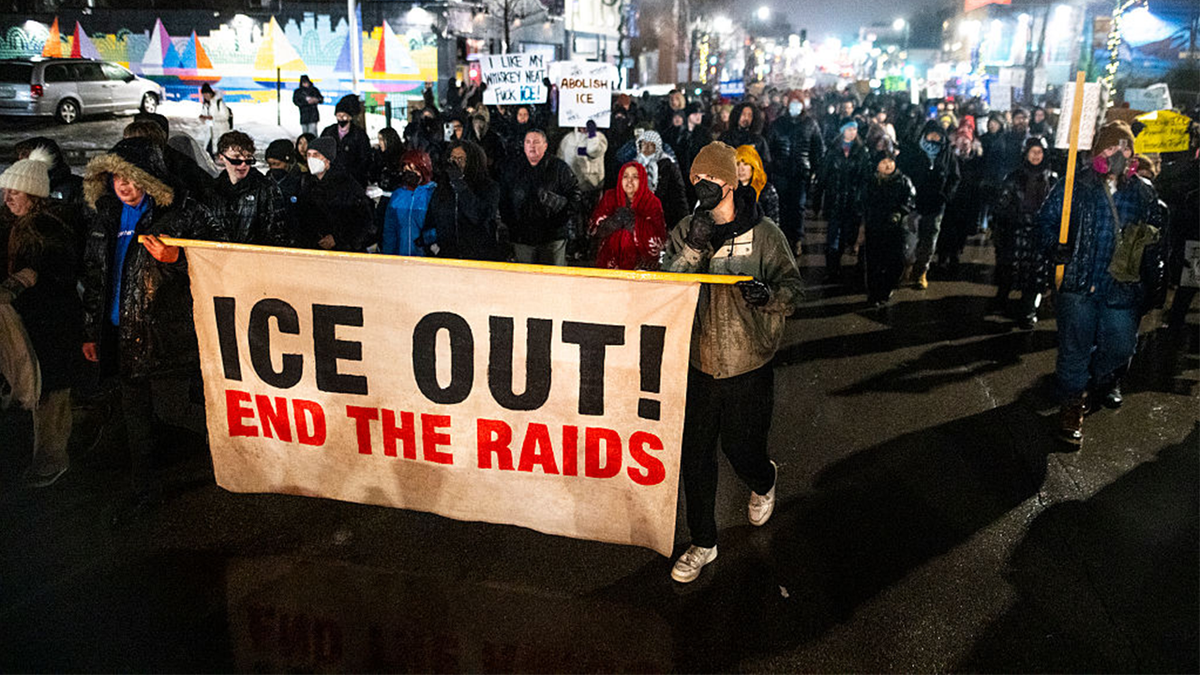
Every Saturday for the past 25 years, I’ve had to walk into my synagogue in Ann Arbor, Mich., past protesters holding the most vile, libelous, antisemitic signs and chants imaginable.
“Jews bomb hospitals.” “Jews bomb schools.” “Jewish power corrupts.”
The protesters don’t show up on Mondays, of course. They come only on Shabbat, so only families going to pray must run the same gauntlet.
New Yorkers got a taste of our weekly ordeal when a pro-Hamas mob harassed congregants outside Manhattan’s Park East Synagogue a few months ago.
That horror prompted Albany to consider creating 25-foot buffers around houses of worship, and City Hall is considering a plan to let police set security perimeters of up to 100 feet when needed.
Both measures are common sense: They don’t silence anyone. They tell protesters, take a few steps back and let people pray.
This isn’t a free speech issue. It’s a safety and harassment issue.
My friends, neighbors and their children shouldn’t have to squeeze past a wall of bile to reach the front door. Neither should anyone.
America already has a federal law — the FACE Act — that bars access to clinics and houses of worship by protesters and protects those sites from acts of force, threats or physical obstruction.
It applies, for example, when someone chains a door, shoves a worshiper or menaces them with violence.
But when the tactic is to assemble every Sabbath, park inches from the entrance and drown families in abuse — and fear — until they stop coming, FACE doesn’t prevent it.
It wasn’t written for persistent, targeted close-proximity intimidation that chills worship — but avoids physically touching the building’s door.
I learned that the hard way. In a lawsuit I co-filed, Gerber v. Herskovitz, the Sixth Circuit held that the weekly protests — timed to our services and aimed only at us — are not prohibited by the FACE Act, and thus are considered “protected” speech.
The judge ordered me and another plaintiff to pay the protesters’ ACLU lawyers $158,721.75.
Try explaining to your friends that you had to write a check for wanting to pray in peace.
New York’s proposed 25-foot buffer and a flexible, up-to-100-foot security perimeter show how lawmakers are trying to address this problem within the bounds of the First Amendment’s “time, place and manner” limits.
The goal isn’t to silence protest. If you want to spew hatred against my religion, you are free to do so.
You could stand outside Michigan Stadium on a Saturday and share your views with 110,000 attendees — but just not on the threshold where my elderly neighbors and young children are exercising their constitutionally protected First Amendment right.
It’s true that towns and states could adopt their own buffer laws. But a patchwork of local rules turns a basic right into a ZIP-code lottery.
Intimidation tactics migrate to the weakest jurisdiction.
A federal baseline sets one clear line everywhere and lets the Justice Department step in when locals can’t or won’t.
Congress should pass a law barring targeted protests within a reasonable distance of entrances, driveways or parking lots of houses of worship during service hours, with authority for local police to extend that perimeter when necessary for safety or crowd control.
That would provide protection not only from physical obstruction, but from targeted intimidation that drives worshippers away.
That’s it. No gag rule — just space to worship, as guaranteed by the First Amendment.
This is not only a Jewish story, by the way. Churches, mosques, temples, Gurdwaras — every faith community has seen intimidation tactics metastasize from the internet to the front steps.
If you value religious freedom, you should want a buffer that protects it in practice, not just on paper.
A society where people can worship without fear is a healthier one. Research suggests regular service attendance is linked with better mental and physical health.
You don’t have to believe that, but you should have to respect your neighbor’s right believe it — and to pray freely.
Next Saturday, I’ll take that walk again. I’ve done it for 25 years, and I’m not stopping.
The question now is whether America will finally walk with me.
Marvin Gerber is a longtime resident of Ann Arbor, Mich., and a member of Beth Israel Congregation.