Throughout his political career, President Donald Trump has alleged that noncitizens are voting illegally in U.S. elections, and that Democrats are allowing or even encouraging it. In Tuesday’s State of the Union address, he declared that “cheating is rampant in our elections” and that Democrats can only win by cheating. The president has talked about “nationalizing” voting in this year’s midterms, and recently said the federal government “should get involved” in elections in Democratic-run cities such as Philadelphia and Detroit “if they can’t count the votes legally and honestly.”
There is no evidence of systemic or large-scale fraud in recent federal elections. Comprehensive audits of state voter records have uncovered only a tiny number of noncitizens, of which even fewer had actually cast a ballot. But none of this has dissuaded Mr. Trump, who has urged federal law enforcement to find and prosecute ineligible voters.
Republican allies of Mr. Trump say that greater scrutiny is necessary to detect even rare cases of illegal voting and to restore public confidence in elections. Democratic lawmakers and many experts on elections administration say it is Mr. Trump’s own rhetoric that is corroding trust in elections, and that the process has been subjected to exhaustive scrutiny since he refused to accept his defeat in 2020. (Mr. Trump has not questioned the legitimacy of the elections that he won.)
Why We Wrote This
President Donald Trump has issued orders to tighten rules around voting and demanded states turn over voter rolls. Last month, the FBI raided an election center in Georgia. Most of these moves are being fought over in court, as the fall midterm elections approach.
Election officials in Democratic-run states are reportedly bracing for potential pre- and post-election interference by the Trump administration, gaming out how they might respond if, for example, federal agents are deployed to polling centers or ordered to seize ballots if disputes arise. A senior Department of Homeland Security official told state election officials Wednesday that immigration enforcement officers wouldn’t be deployed to the polls, Politico reported.
Voters have become less trusting of elections over the past year, according to a poll by the University of California, San Diego taken between December and January. Only 60% of eligible voters expressed confidence that their midterm votes would be counted fairly, down from 77% shortly after the 2024 election, with declines across all partisan affiliations.

The Trump administration has tried to muster executive authority to dictate how elections are run, issuing executive orders and demanding that states comply. Courts have blocked most of these orders on constitutional grounds; elections are the prerogative of states, not of the federal government. Congress has also taken up GOP-written legislation that would compel states to require proof of citizenship for voter registration and would tighten voting rules. The act has passed the House but is stalled in the Senate.
But perhaps the biggest show of federal authority came last month in Fulton County, Georgia, when the FBI raided an election center and seized boxes of ballots as part of a criminal investigation into the 2020 election.
Critics say the Fulton County raid shows how far the Trump administration is prepared to go to pursue its goals. “I think it’s a test case. … You’ve seen it over and over again in this administration: Just push the boundaries and see who’s going to stop you,” says Gilda Daniels, a law professor at the University of Baltimore who previously served in the Civil Rights Division of the Department of Justice. “I don’t think this is the last of these attempts.”
Why is the FBI investigating the 2020 election in Georgia?
The FBI seized hundreds of boxes of ballots, voter rolls, and other materials in Fulton County, which includes Atlanta, on Jan. 28. An affidavit submitted to a magistrate judge to secure a search warrant presented “probable cause” of criminal wrongdoing by county officials who oversaw the 2020 election. Mr. Trump lost in Georgia by a narrow margin; Fulton County went for his opponent, Joe Biden.
The allegations are familiar to Georgia election officials, who previously investigated irregularities in Fulton County. Mr. Trump and his allies failed to prove any wrongdoing in court or during multiple ballot recounts in 2020, but have kept amplifying their allegations. Some complaints are grounded in facts: Fulton County scanned some ballots twice during a machine recount. The recounts did turn up more votes for Mr. Trump, but not enough to make a difference, and state officials found no evidence of intentional misconduct.
Other claims in the affidavit have already been debunked and are sourced to right-wing activists allied to Mr. Trump. Fulton County election officials have sued, saying the raid was based on misleading information, and demanding the ballots be returned. A hearing scheduled for Friday was postponed until mid-March.
Mr. Trump’s efforts to reverse his defeat in Georgia by urging state officials to “find” him 11,780 more votes led to his indictment in 2022 in Fulton County on charges of racketeering and other allegations. The case brought by District Attorney Fani Willis was later derailed by accusations of prosecutorial misconduct and never went to trial.
Mr. Trump’s praise of last month’s FBI raid in Fulton County – which included the highly unusual on-site presence of his director of national intelligence, Tulsi Gabbard – highlights the political stakes. It speaks to Mr. Trump’s insistence on relitigating his 2020 defeat, which he still claims was rigged, and his determination to exert more federal control over elections. And it is already casting a shadow over how states prepare for this year’s midterms.

The seizure of ballots and other materials from Fulton County set off alarms among election officials across the United States, says Tammy Patrick, a former elections official in Maricopa County, Arizona. State laws restrict who can access sensitive materials. If they’re removed, “then you have lost all chain of custody,” she says. “This is something we have not seen before.”
Election officials take oaths to uphold state and federal laws. Going forward, “everyone is just making sure that their own statutes protect the integrity of the materials that they have … a sworn constitutional duty to secure,” says Ms. Patrick, who is a programs officer at the National Association of Election Officials.
Why is the Department of Justice suing states to force them to submit voter data?
Attorney General Pam Bondi has asked states to submit their complete voter registration rolls to the federal government for accuracy checks, citing federal law. The administration contends that checking state voter rolls against federal databases can help uncover cases of noncitizen voting. Some states have complied, but others have declined, citing privacy laws. Democratic officials in these states have also questioned what the federal government will do with the data.
The Department of Justice has responded by suing 24 states and the District of Columbia. These states are virtually all Democratic-run, though some Republican-run states, such as West Virginia, have also refused to comply, arguing that states are responsible for running elections and already maintain accurate voter records. So far, courts have sided with the states by dismissing the DOJ’s lawsuits.
Louisiana is one of the states that has complied with the DOJ’s request. In September, Louisiana Secretary of State Nancy Landry, a Republican, announced that the state had found 390 noncitizens who had registered to vote, of which 79 had voted in past elections. “I want to be clear: noncitizens illegally registering or voting is not a systemic problem in Louisiana,” Ms. Landry said in a statement. (Louisiana has around 3 million registered voters.)
These numbers may be wrong, though, because the federal database used to cross-check voting rolls is unreliable. Utah Lt. Gov. Deidre Henderson, a Republican, said in a January statement that election officials had found the database to be “notoriously inaccurate” in flagging its citizens as ineligible to vote. (ProPublica has uncovered similar problems.) Utah’s own citizenship review of voters – it declined the DOJ’s demand to submit private voter data – found one registration of a noncitizen who had never voted.
Ms. Henderson shared her own experience: In 2022, she didn’t receive a mail ballot because the county clerk had wrongly marked her as a noncitizen during “a too-aggressive scrubbing” of voter rolls because she was born on a NATO base in the Netherlands.
Clerical errors happen, says David Becker, a former DOJ attorney who directs the Center for Election Innovation & Research, a nonprofit. But the men and women who run elections aren’t playing political games, he says. “Election officials want every eligible voter to vote and only eligible voters to vote. The most liberal Democrat doesn’t want an ineligible voter to vote, and the most conservative Republican doesn’t want to disenfranchise an eligible voter.”
National Conference of State Legislatures
|
Jacob Turcotte/Staff
How could proof-of-citizenship requirements affect the midterms?
A bill that passed the House in January would require people to submit a passport or birth certificate to register to vote in federal elections, with some exceptions, and to present a photo ID when casting a ballot in person. Republicans say the SAVE America Act, which also includes provisions for sharing voter rolls with the federal government, would enhance election security and shouldn’t present a problem for eligible voters. Democratic lawmakers have opposed the bill, saying it would suppress turnout and cause hardship for citizens without proper documentation.
Matthew Germer, a governance expert at R Street, a Washington-based think tank that favors limited government, says the bill provides an upgrade of existing safeguards even if claims of widespread electoral fraud aren’t supported by evidence. “It gives people more confidence that their elections are being conducted with integrity,” he says.
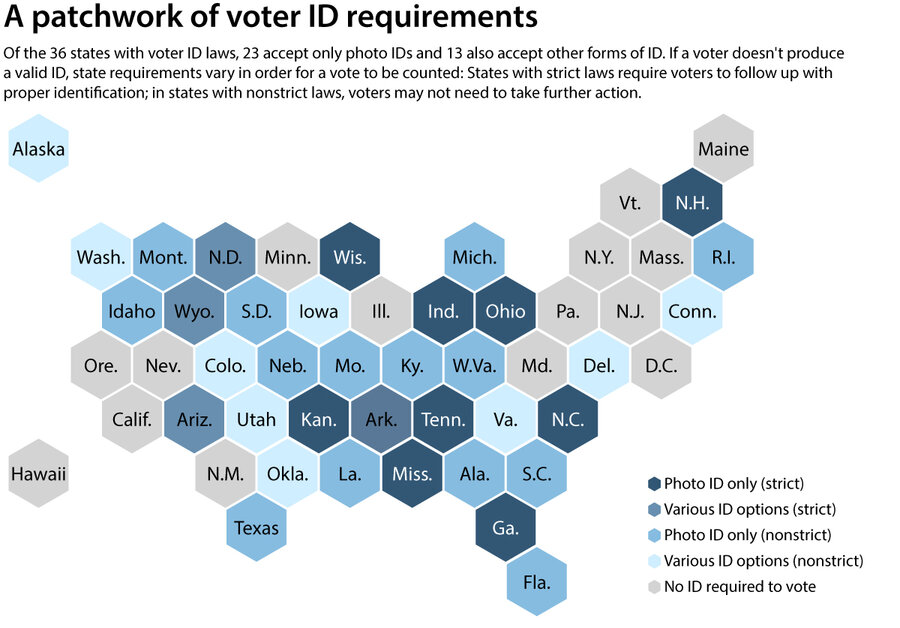
But he cautions that the political rhetoric from Republicans about the need to pass the bill, which Mr. Trump echoed in Tuesday’s speech, may diminish trust in an already secure system. A majority of states already require voters to show photo identification.

Republicans in the Senate lack the votes to pass the bill on their own without suspending the filibuster, a move that Majority Leader John Thune opposes. He has also quashed calls to use a “talking filibuster.”
Polls show a large majority of voters from both parties support the forms of verification in the SAVE America Act. At the same time, studies show that voter ID laws don’t always have a major effect on turnout and can motivate voters who oppose them.
Arizona passed a proposition in 2004 to require proof of citizenship to register to vote in state elections. Ms. Patrick worked on its implementation, which she calls a bumpy process. “You had people who had been voting literally for decades but didn’t have the paperwork.”
The burden fell more on older and rural voters, on people with disabilities, and on tribal members, says Ms. Patrick. She thinks the provisions in the SAVE America Act would “impact more Americans and prevent them from participating than I think people realize.”
“There’re going to be Democrats, there’re going to be Republicans, there’re going to be unaffiliated voters. It’s exactly what we saw in Maricopa County,” she says.
A survey taken last year by the Center for Democracy and Civic Engagement at the University of Maryland found that 9% of voters didn’t have ready access to documents such as birth certificates that could prove their citizenship. Roughly half of Americans hold passports.
Some GOP strategists believe stricter verification laws would confer a partisan advantage to the GOP. But the electoral coalition that backed Mr. Trump might actually be more impacted by stricter rules, says Mr. Becker.
Democrats are more likely to hold passports, for example. Single women, who skew Democratic, don’t face the barriers in proving citizenship as married women who changed their last names. The young and disaffected men who flocked to Mr. Trump may not have the proper paperwork on hand or be inclined to hunt it down to vote in a midterm election.
“There’s such an adherence to this false mythology about elections, coming primarily from the White House, that no one appears to be really giving thought to, ‘Hey, is this actually going to do what we think it’s going to do?’” says Mr. Becker.