PORTO ALEGRE, Brazil — When President Trump returned to the White House last year, observers in Brazil expected immediate hostility towards leftist President Luiz Inácio Lula da Silva, who in 2022 had defeated the far-right former president and MAGA ally Jair Bolsonaro.
The expected clash with Trump came in July, when he imposed 40% tariffs on Brazilian exports, revoked U.S. visas of several public officials and then imposed sanctions against a Supreme Court justice, Alexandre de Moraes, who was presiding over a trial of Bolsonaro and his staff.
Bolsonaro and others were accused of attempting to carry out a coup d’etat. Bolsonaro supporters broke into government buildings in January 2023, violence many in Brazil likened to the storming of the U.S. Capitol by Trump supporters on Jan. 6, 2021.
Trump denounced Bolsonaro’s prosecution as a witch hunt and, writing on social media, demanded, “This trial should end immediately!”
But by November, the White House had eased tariffs on key Brazilian exports, such as beef and coffee, and it lifted sanctions against De Moraes in December and began signaling appreciation for Lula. There’s now talk that Trump and Lula will meet this year.

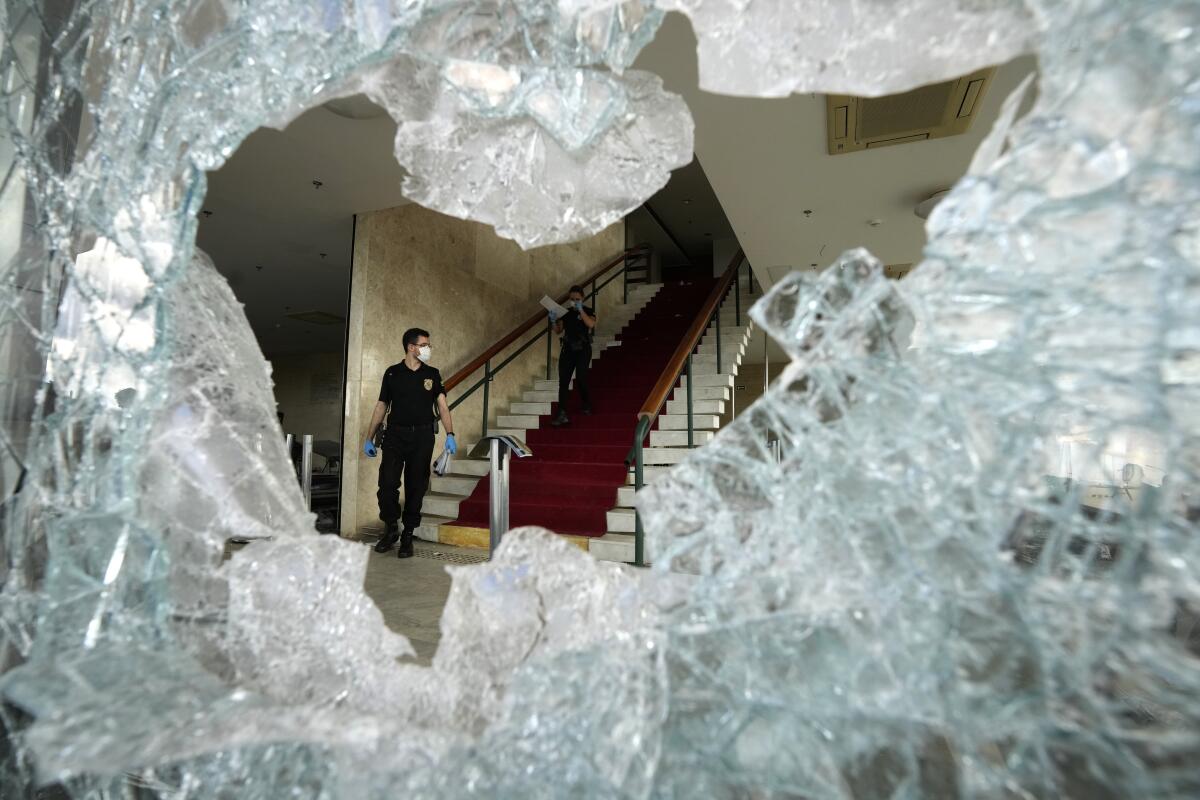
Forensic investigators are framed by a cracked window damaged when supporters of Brazil’s former president, Jair Bolsonaro, stormed the nation’s Supreme Court building in Brasilia on Jan. 10, 2023.
(Eraldo Peres / Associated Press)
The shift in U.S.-Brazilian relations came about, observers say, because Brazil stood up to Trump on Bolsonaro and other matters and the fact that Brazil has something the U.S. wants: a large supply of rare-earth minerals.
“Trump’s expectation was that Brazil would bring some offer [regarding Bolsonaro] to the table, but it didn’t do that, largely because the demands he made crossed a red line and were seen as interventionist,” said Oliver Stuenkel, a political science professor at the Getúlio Vargas Foundation’s School of International Relations in São Paulo. “There was simply no way that Lula could have asked the Supreme Court to stop prosecuting Bolsonaro.”
Bolsonaro was convicted and is now serving a 27-year sentence in prison.
Besides trying to bend the Brazilian justices to his will on Bolsonaro, Trump tried to prevent Brazil from imposing new regulations on big tech firms to compel them to moderate content more vigorously. That effort also failed.
Since 2014, social media companies in Brazil could be fined if they didn’t comply with court orders. However, in July last year, the Supreme Court established that these companies have “a duty of care” over content regarded as criminal under Brazilian law. For example, now they are required, without prior request, to remove posts promoting racism, encouraging suicide or pushing for the overthrow of the government.
The Trump administration is now hoping to get access to Brazil’s rare earths, a class of minerals essential to high-tech products such as electric vehicles and hardware for artificial intelligence data centers. Brazil holds the world’s second-largest reserves of these critical metals, while China ranks first, according to the U.S. Geological Survey.
“At some point, Trump realized Lula had more to offer to him, including a groceries’ inflation reduction [with a tariff lift], than Bolsonaro, who was arrested, convicted, and has been losing his political importance in Brazil,” said Bruna Santos, a director of the Brazil Program at Inter-American Dialogue, a think tank in Washington.
In December, after speaking with Lula by phone, Trump posted on his social media website that they had “set the stage for very good dialogue and agreement long into the future” and that “much good will come out of this newly formed partnership.”
Much of the renewed goodwill toward Brazil stems from Trump’s aim of challenging China’s dominance of the world’s rare earths supply. For 19 out of 20 strategic minerals, the Asian country is the leading refiner, with an average market share of 70%, according to the International Energy Agency.
“Looking more broadly, president Trump’s second term has clearly prioritized renewed engagement with partners in the Western Hemisphere, both for security reasons but also to counter Chinese influence in the region,” says Valentina Sader, a director at the Atlantic Council’s Adrienne Arsht Latin America Center.
On Feb. 4, Vice President JD Vance announced an effort to create an alliance that would engage in the mining, processing and trading of rare earths. It included a $565-million loan to the company Serra Verde,
the only company in Brazil mining rare earths. The country’s large rare-metals deposits are still largely unexplored due to a lack of capital and expertise.
One day after Vance launched the alliance, Lula told Brazilian news website UOL that he’s arranging a visit to Washington soon. One of the topics on the agenda will be rare earths.
“One of the strategies we’re seeing in the Trump administration is basically to make a big threat, impose high tariffs, then sort of see what the other side is willing to give up and offer,” Stuenkel said. “In some cases it actually worked, but not with Brazil since it’s no longer dependent on the U.S.”
As for tariffs, some were reduced in November after it became apparent they targeted some products, such as coffee, essential to Americans’ daily lives. Then, after the recent U.S. Supreme Court ruling invalidated Trump’s tariffs, the president enacted a new global 15% import tax with a few product and sector exceptions, such as beef and pharmaceuticals. The outcome, however, still benefits Brazilians.
The new executive order represented a 13.6% decrease in overall tariffs against Brazil compared with earlier ones, making the country the largest beneficiary of the policy shift, according to Global Trade Alert, a nonprofit platform that tracks policy changes in global trade.
The White House still has a 40% tax in place on Brazil’s steel and aluminum, but the Supreme Court ruling represents a relief for more than $21 billion in Brazilian exports to the U.S., according to the country’s National Confederation of Industry.

People wearing masks depicting President Trump and former Brazilian President Jair Bolsonaro take part in a protest in São Paulo on July 18, 2025.
(Nelson Almeida / AFP/Getty Images)
The Trump administration has aimed to counter China’s influence in the Western Hemisphere, but many countries in South America are no longer willing to boldly move away from China, which became the continent’s major trading partner in the 2010s.
In fact, Trump’s insistence that the U.S. have sway over “its hemisphere” may actually strengthen Beijing’s presence in Latin America, Stuenkel said.
Referring to Javier Milei, Argentina’s far-right president and a Trump ally, Stuenkel said, “Even Milei, who signed a trade deal with the U.S., has no intention to significantly downgrade economic ties to China, which are hugely important to the Argentine economy.”
In Brazil’s case, there’s also the long-standing diplomatic tradition of nonalignment with the world’s major powers. The country exports to both the U.S. and China — mainly steel, fuels and aerospace products to Americans, and mostly soybeans, iron ore and crude petroleum to the Chinese.
“It would be unfeasible for Brazil to choose” between the U.S. and China, Santos said. “It could push Brazilian industry to a fragmentation, with one catering to the American market, and another one to the Chinese.”
Nakamura is a special correspondent writing for The Times under the auspices of the International Center for Journalists.