Good morning. You’re reading the Up First newsletter. Subscribe here to get it delivered to your inbox, and listen to the Up First podcast for all the news you need to start your day.
Today’s top stories
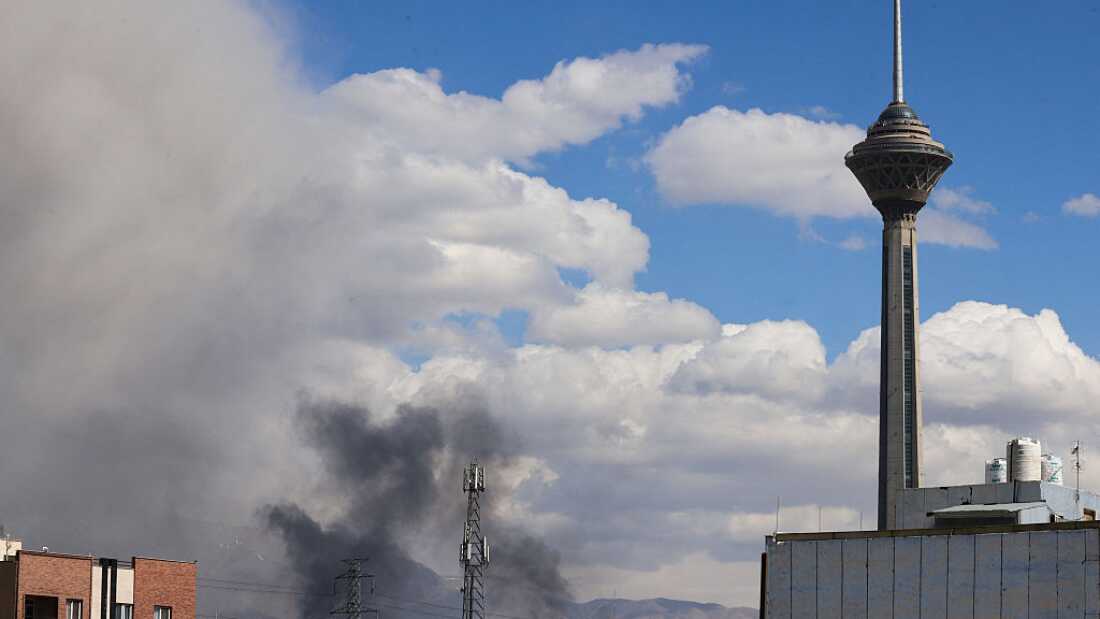
The U.S. and Israel’s war over Iran has engulfed more of the Middle East as it enters its third day. Last night, the Iranian-backed militant group Hezbollah launched rockets into Israel for the first time in more than a year. Israel responded with air strikes in Beirut and southern Lebanon. Iran is targeting neighboring countries that host American military bases. The Pentagon says three U.S. service members were killed over the weekend. Congress is set to vote on bipartisan war powers resolutions this week aimed at limiting President Trump’s military operations in Iran. The dual efforts in the House and Senate face uphill battles to become law, as previous attempts to assert congressional authority to declare war have failed.

A plume of smoke rises following reported explosions in Tehran on March 1, 2026.
Atta Kenare/AFP via Getty Images
hide caption
toggle caption
Atta Kenare/AFP via Getty Images
- 🎧 On Up First, NPR’s Jackie Northam says she spoke to people in Iran about the death of their supreme leader, Ayatollah Ali Khamenei. Reviews were mixed. Some said they’re very happy about his death. On social media, some have been seen pulling down his statues. But large crowds also attended pro-regime rallies mourning his death.
- 🎧 The White House told NPR that Iran wants to restart nuclear talks and that Trump will eventually speak with whoever is in charge. But a top Iranian security official on X said Iran will not negotiate. Trump said the U.S. will continue full-force combat operations in Iran until his objectives are met, though he hasn’t specified what those specific objectives are. Without knowing what the U.S. wants to achieve, it is hard to predict how long the war will last, NPR’s Franco Ordoñez says.
- 🎧 If Iran continues to retaliate against the U.S. by targeting its Arab neighbors, these Gulf Arab states could decide to strike back, widening the war further, NPR’s Aya Batrawy says. The U.K., France and Germany say they will take steps to defend their allies’ interests in the region. Saudi Arabia says Iranian drones targeted one of its largest oil refineries today. Oil prices rose sharply when market trading began yesterday.
- ➡️ See photos of Iran, Israel and reactions from around the world over the airstrikes. Satellite images offer a unique look at the destruction inflicted upon Iran’s military facilities.
- ➡️ Several episodes of NPR’s Throughline explain the historical context of the U.S.’ relationship with Iran as well as the protests that set the stage for this weekend’s attacks. Listen to the YouTube audio playlist.
The Supreme Court hears arguments today in a high-stakes gun case that has united a rare array of people, from conservative gun rights groups to liberal civil liberties groups. At the heart of the battle is a federal law banning drug users from owning firearms. It is the same law used to prosecute Hunter Biden, the son of former President Joe Biden, for illegal gun possession. This time, the justices must decide if the government can criminalize gun ownership for marijuana users.
The ongoing Texas primaries offer the first real test of whether the Republican Party can keep its hold on influential Latino swing voters. These voters fueled Trump’s 2024 victory, helping him win in parts of the state where the GOP has historically struggled. However, recent shifts suggest that Texas’ Latino population may be beginning to back away from the political party.
Life advice

Elizabeth Kanagawa, a certified child passenger safety technician and the owner of Three Littles, a children’s store that sells strollers and car seats in Washington, D.C, demonstrates how to adjust the harness of a car seat.
Beck Harlan for NPR
hide caption
toggle caption
Beck Harlan for NPR
Parents: Chances are, you might not have your child’s car seat installed correctly. According to data from the National Digital Car Seat Check Form, 74% of the almost 60,000 car seats that child passenger safety technicians (CPSTs) checked in 2025 were not being used as intended by the manufacturer. Car accidents are a leading cause of death among U.S. children, according to a National Highway Traffic Safety Administration report. Correctly used car and booster seats significantly reduce this risk. Learn what a secure car seat base and a tightly fastened tether look like with Life Kit’s visual guide.
- 🚗 The top mistake parents make with car seats has to do with the seat belt. The car seat shouldn’t move more than one inch side to side or front to back when you secure it in a fastened seat base. Firmly shake it to confirm.
- 🚗 The harness height depends on whether your child’s car seat faces forward or rearward. Place the harness at a height that controls the child’s movement and reduces the risk of injury. For example, in a forward-facing seat, set it at or slightly above the shoulder.
- 🚗 The long straps that hang off your child’s car seat are not optional. Attach these critical tethers to your vehicle’s back seat anchor point, which is located on the rear shelf, seat back, ceiling or floor.
For more tips on how to correctly install a car seat, listen to this episode of NPR’s Life Kit. Subscribe to the Life Kit newsletter for expert advice on love, money, relationships and more.
Behind the story
by Chris Bentley, Here & Now producer and Peter O’Dowd, Here & Now host

A moose in Minnesota wears a collar that collects GPS location data.
Courtesy of Morgan Swingen
hide caption
toggle caption
Courtesy of Morgan Swingen
Taking a hike is a great way to put things in perspective. Here & Now‘s environmental series Reverse Course recently took us to some pretty remote places as we tagged along with scientists trying to protect two charismatic animals from the effects of climate change.
Peter summited a “sky island” in southern Arizona. He ascended from the heat of the desert into a snow-capped forest, all in search of an elusive endangered species called the Mount Graham red squirrel — so-named because it lives only on that one mountain.
Chris searched the boreal forest of Minnesota’s Arrowhead Region for moose. He followed scientists with the state and two local tribes as they scanned the wilderness on snowmobiles and helicopters for 9-month-old moose calves.
We were 1,500 miles apart but had similar moments of realization in the woods: The churn of the news, political posturing and internet chatter seem so insignificant in the silence of the forest, hours from other humans, watching snow accumulate in a bull moose’s antlers or a tiny squirrel going about its routine of stashing pinecones as if it’s not one of only about 200 individuals left on the planet.
Of course, what humans do matters very much to those animals, which is why we were there in the first place, speaking with scientists about climate change and habitat conservation. In our stories for Here & Now, we tried to convey our sense of awe and help people imagine a world with more space for nature, wild places and non-human ways of life.
Come take a hike with us on our podcast, Here & Now Anytime.
3 things to know before you go

A screenshot from George Mélière’s Gugusse et l’Automate. The pioneering French filmmaker’s 1897 short, which likely features the first known depiction of a robot on film, was thought lost until it was found among a box of old reels that had belonged to a family in Michigan and restored by the Library of Congress.
The Frisbee Collection/Library of Congress
hide caption
toggle caption
The Frisbee Collection/Library of Congress
- The Library of Congress has found and restored a long-lost silent film, Gugusse et l’Automate, by Georges Méliès. Méliès made the film nearly 130 years ago.
- NASA is redirecting its Artemis lunar program and delaying a planned astronaut landing. Instead of landing on the moon on Artemis III, NASA hopes to do so on Artemis IV.
- OpenAI announced it has struck a deal with the Defense Department to provide its technology for classified networks. The development came shortly after the president banned the artificial intelligence company Anthropic.
This newsletter was edited by Suzanne Nuyen.