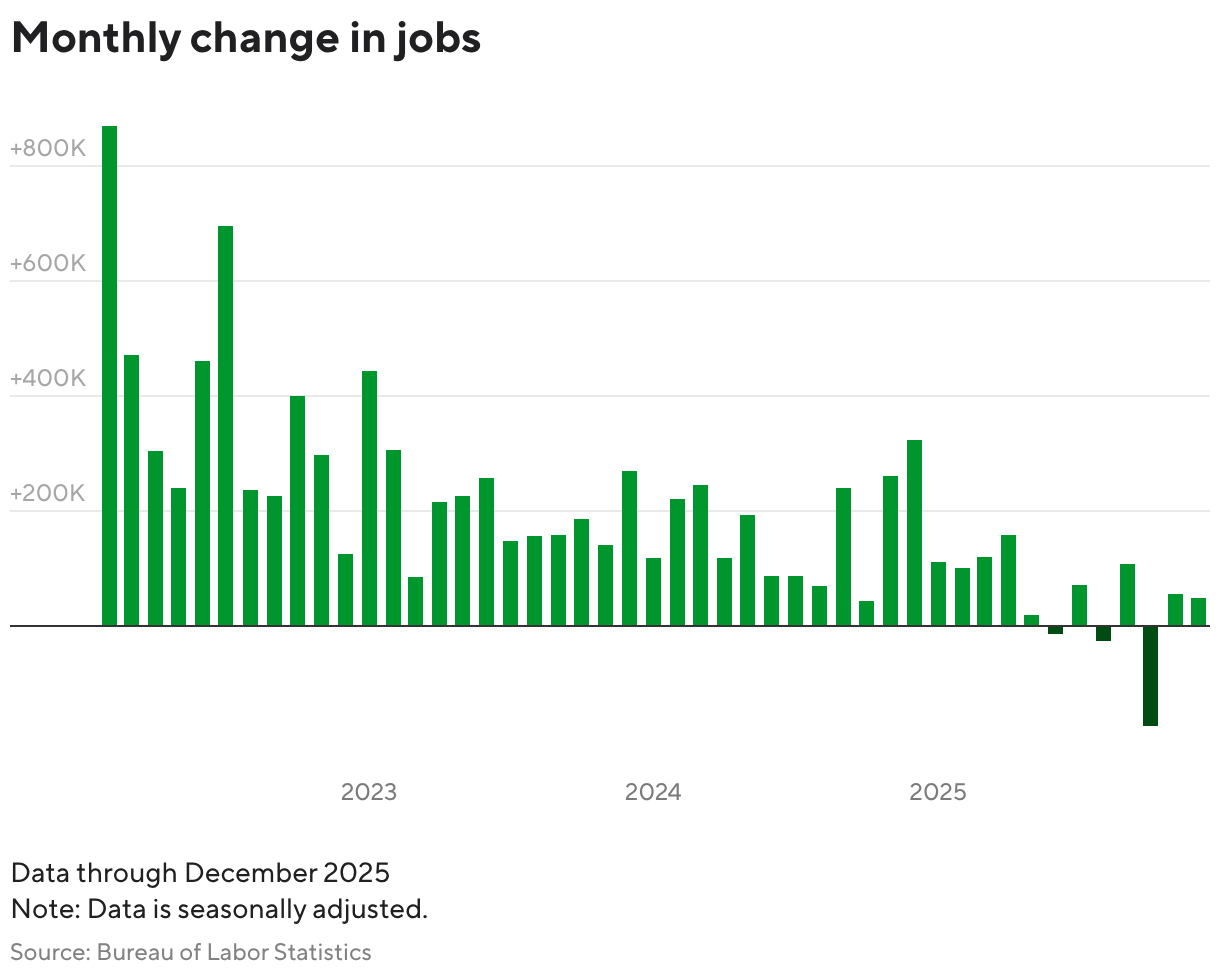
Stocks opened sharply lower on Friday after new government data pointed to a weakening U.S. labor market and as concerns mount about the impact of the Iran war on the U.S. economy.
The S&P 500 fell 83 points, or 1.2%, to 6,747, in early trading, while the Dow Jones Industrial Average dropped 647 points, or 1.3%, and the Nasdaq Composite sank 1%.
The declines followed a steep drop on Thursday, with the Dow losing 785 points, or 1.6%, and the S&P 500 and Nasdaq falling 0.6% and 0.3%, respectively.
Big miss
The downturn came after the release of the February employment report, which showed employers shed 92,000 jobs in February, undershooting economists’ forecasts of 60,000 payroll gains.
“You can’t sugarcoat this report,” said Brian Jacobsen, chief economic strategist at Annex Wealth Management. “A negative payrolls number combined with a big jump in oil prices will have traders worrying about stagflation risks.”
Analysts said a nurses’ strike last month, which drove down health care gains, and harsh winter weather may have distorted the labor data. Still, the weak employment numbers injected more uncertainty into the economy at a time when investors are already fretting over the economic fallout of the Iran war.
“If the labor market keeps losing steam, it becomes a more delicate backdrop — especially with geopolitical uncertainty on the rise and energy prices capable of acting as an added tax at the gas pump,” eToro U.S. investment analyst Bret Kenwell said in an email.
Oil prices jump
The price of oil continued to surge on Friday amid growing concerns that the Iran war will disrupt global crude supplies. West Texas Intermediate, the U.S. oil benchmark, rose 9.5% to $88.74 per barrel on Friday morning, according to data from Factset. Brent crude, the international benchmark, jumped 6.8% to $91.13. Both were trading near their highest levels since April 2024.
Crude prices have surged this week as the Iran conflict halts shipments of oil and liquefied natural gas through the strategically vital Strait of Hormuz.
Ryan McKay, senior commodity strategist at TD Securities, said in a report that the price of Brent crude could top $100 a barrel by next week if oil tankers remain unable to traverse the Strait of Hormuz.
If prices break above that threshold and remain elevated for several months, it could cause a material increase in inflation and spur additional job losses, Mark Luschini, chief investment officer at Janney Montgomery Scott, told CBS News.
“If [the war] metastasized into something that drew in other countries, particularly adversaries like Russia and China, in a more overt and kinetic fashion, that would obviously exaggerate worries.”
At the same time, Luschini and other Wall Street analysts noted investors’ tendency to look through geopolitical conflicts, which often supports financial markets.
“For equities, the risks are plainly growing, but the U.S. stock market has proven remarkably resilient, and we think that bodes well,” James Reilly, senior market strategist for Capital Economics, told clients in a research note. “For example, if we step back from today’s data — which was plainly negative but, in our view, not indicative of major labour market weakness — U.S. equities had largely shrugged off surging oil prices this week.”
Sticky situation for the Fed
Friday’s weak employment report and inflationary pressure from the Iran war is likely to complicate the Federal Reserve’s decision-making on interest rates.
Lowering rates, as President Trump has repeatedly called for, could bolster job and broader economic growth. But reducing borrowing costs when the economy remains near full employment and energy costs are spiking could fuel inflation, which remains above the Fed’s 2% annual target.
The Fed is scheduled to announce its next rate on Feb. 18.