Video appears to show U.S. Tomahawk missile hitting the area of the deadly school strike in Iran

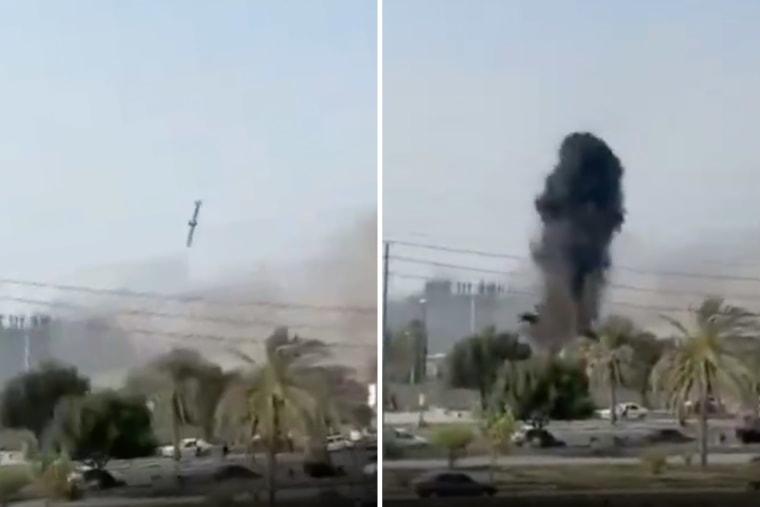
Published Sunday by Iran’s semiofficial Mehr News Agency, the footage was first geolocated by the online research group Bellingcat which said a Tomahawk — an American-made, long-range cruise missile — was used in the attack near a compound that was once home to an IRGC military.
Several munitions experts agreed with that analysis, including N.R. Jenzen-Jones, the director of arms intelligence firm Armament Research Services.
The footage “appears to show a Tomahawk missile,” he said in an email Sunday. “This would indicate a U.S. strike,” he said, adding that the U.S. was the only party in the war known to have Tomahawk missiles.

Jeffrey Lewis, the director of the East Asia Nonproliferation Program at the Middlebury Institute of International Studies at Monterey, California, also said in an interview Monday that he thought “the munition that is visible in that video is clearly a tomahawk.”
“It’s long, cylindrical. It has a set of wings. And really no other country in this conflict has a munition that looks like that,” he said. He added that it was “incredibly accurate” because it had Digital Scene Matching built in. There will be “an onboard photograph of the thing that it’s supposed to hit, and Tomahawk will look, it will match, and then it will strike,” he said.
It is “rare that a Tomahawk misfires” but the U.S. does “have a history” of making targeting errors, retired U.S. Army Lt. Col. Daniel Davis, a Bronze Star winner who served for 21 years, said Monday. “Everybody does.”
“If you just have a satellite image, it’s just a building and so if you misidentify what’s in the building because of other intelligence, then that can lead to improper targeting,” added Davis, now a senior fellow and military expert at Defense Priorities, a Washington-based think tank.

The Pentagon has said it is still investigating the strike, while the Israeli military has maintained it is not aware of any connection between its operations in Iran and the school strike.
Trump on Saturday, told reporters onboard Air Force One that the U.S. was not responsible for the bombing, saying: “In my opinion, based on what I’ve seen, that was done by Iran.”
U.S. Central Command did not comment on the latest video. The White House did not immediately respond to NBC News’ request for comment.

But the Defense Department has acknowledged the use of Tomahawk missiles in the war. On the day of the strike on the school, the Defense Visual Information Distribution Service published a photo and video online of the USS Spruance, firing a Tomahawk land attack missile. It published a similar picture March 3.
The Spruance, an Arleigh Burke-class Aegis guided-missile destroyer, is part of the USS Abraham Lincoln aircraft carrier group.
Iranian officials said that more than 170 people, mostly children, were killed in the strike near the school. NBC News has not been able to independently verify the death toll of the attack.
The attack came hours after the U.S. and Israel launched multiple air and missile strikes on Iran, killing Supreme Leader Ayatollah Ali Khamenei, sparking retaliatory attacks by the Islamic Republic on many of its Middle Eastern neighbors including Saudi Arabia, Jordan and several Gulf states.
Trump administration officials told members of Congress in a closed-door meeting last week that the U.S. had been targeting the area where the school was struck, two U.S. officials told NBC News last week. The administration officials also said their military partner, Israel, was not responsible for the school’s bombing.

And a map published online by the Defense Department highlighting strikes on Iran over the first 100 hours of the military operation appeared to show that the area of Minab had been targeted.
“It is increasingly clear that the U.S. military was responsible for the deadly attack,” Kenneth Roth, the former executive director of Human Rights Watch, said in a text message Monday, adding that it was “hit by a precision weapon, not an errant attack.”
If an error was made, he said, it raises “urgent questions regarding why U.S. intelligence was so shoddy that it treated the school as no different from the adjacent military facility.”