Trump administration asks Supreme Court to let it end deportation protections for 350,000 Haitians

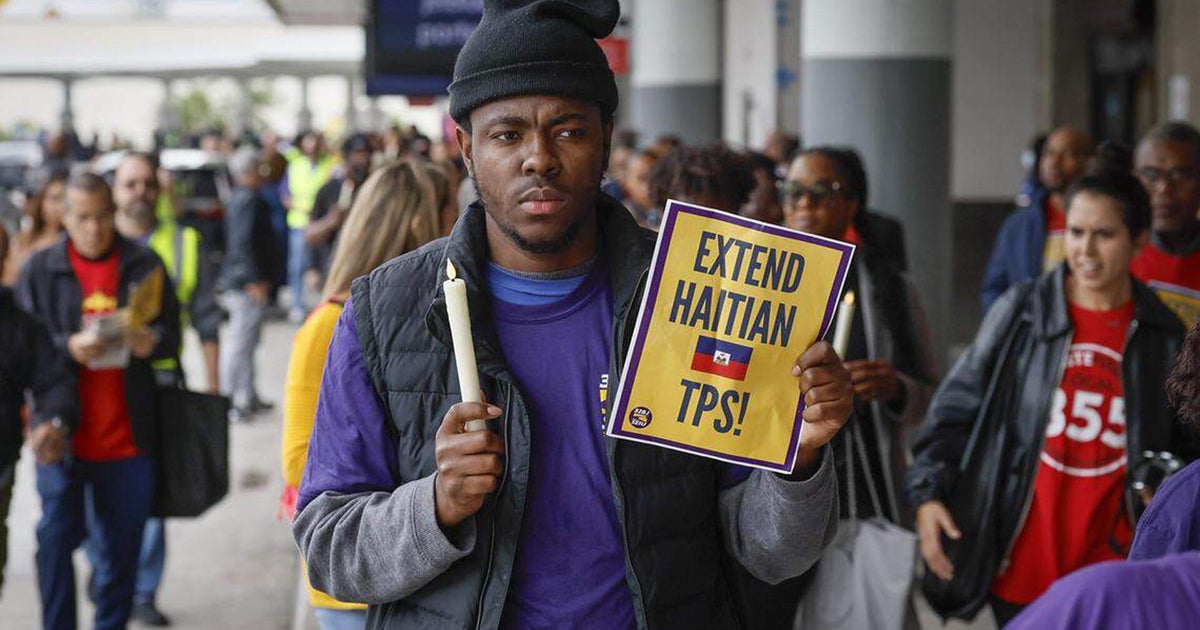
Washington — The Trump administration asked the Supreme Court on Wednesday to clear the way for it to end temporary deportation protections for more than 350,000 Haitian immigrants.
The bid for emergency relief from the Justice Department is the latest arising out of the Department of Homeland Security’s efforts to end Temporary Protected Status for a host of countries, putting immigrants from those places at risk of deportation. The Supreme Court has so far allowed the Trump administration to roll back protections for Venezuelan migrants, and a request involving Syrian immigrants is awaiting action from the high court.
Haitians were first granted Temporary Protected Status in 2010 because of “extraordinary and temporary conditions” following a catastrophic earthquake that left more than 300,000 people dead and devastated the country.
In his first administration, President Trump moved to rescind the protections for Haiti, but the termination was caught up in a court fight and didn’t take effect because he left office.
But after Mr. Trump returned to the White House for a second term, Homeland Security Secretary Kristi Noem took steps to end Haiti’s TPS designation, effective Feb. 3.
Noem determined the decision to end the protections “reflects a necessary and strategic vote of confidence in the new chapter Haiti is turning” and the president’s “foreign policy vision of a secure, sovereign and self-reliant Haiti.” While the secretary acknowledged that certain conditions in Haiti remained “concerning,” Noem said parts of the country were “suitable” to return to.
But in December, a group of five Haitian nationals challenged Noem’s termination of TPS and sought to block the move. A federal district court granted their request last month, finding in part that Noem’s decision to unwind the protections was likely motivated by racial animus.
“Kristi Noem has a First Amendment right to call immigrants killers, leeches, entitlement junkies, and any other inapt name she wants,” U.S. District Judge Ana Reyes wrote. “Secretary Noem, however, is constrained by both our Constitution and the [Administrative Procedure Act] to apply faithfully the facts to the law in implementing the TPS program. The record to-date shows she has yet to do that.”
The Justice Department appealed, and a divided three-judge panel on the U.S. Court of Appeals in Washington, D.C., declined to freeze the lower court’s decision.
In urging the Supreme Court to allow the Trump administration to rescind the deportation protections, Solicitor General D. John Sauer argued that the theory embraced by the lower court threatened to invalidate “virtually every immigration policy of the current administration.”
Lower courts, he said, “are again attempting to block major executive-branch policy initiatives in ways that inflict specific harms to the national interest and foreign relations, while crediting harms to respondents that inhere in the temporary nature of TPS.”
TPS was created by Congress in 1990 and provides temporary immigration protections for people from countries beset by armed conflicts, natural disasters or other “extraordinary and temporary” conditions that make it dangerous for deportees to return. Migrants from a country designated for TPS generally cannot be removed from the U.S. and are authorized to work for the length of the designation, which typically lasts up to 18 months and can be extended.
As part of his immigration agenda, Mr. Trump has moved to end TPS protections for immigrants from at least a dozen countries, including Afghanistan, Haiti, Nicaragua, Somalia and Yemen.