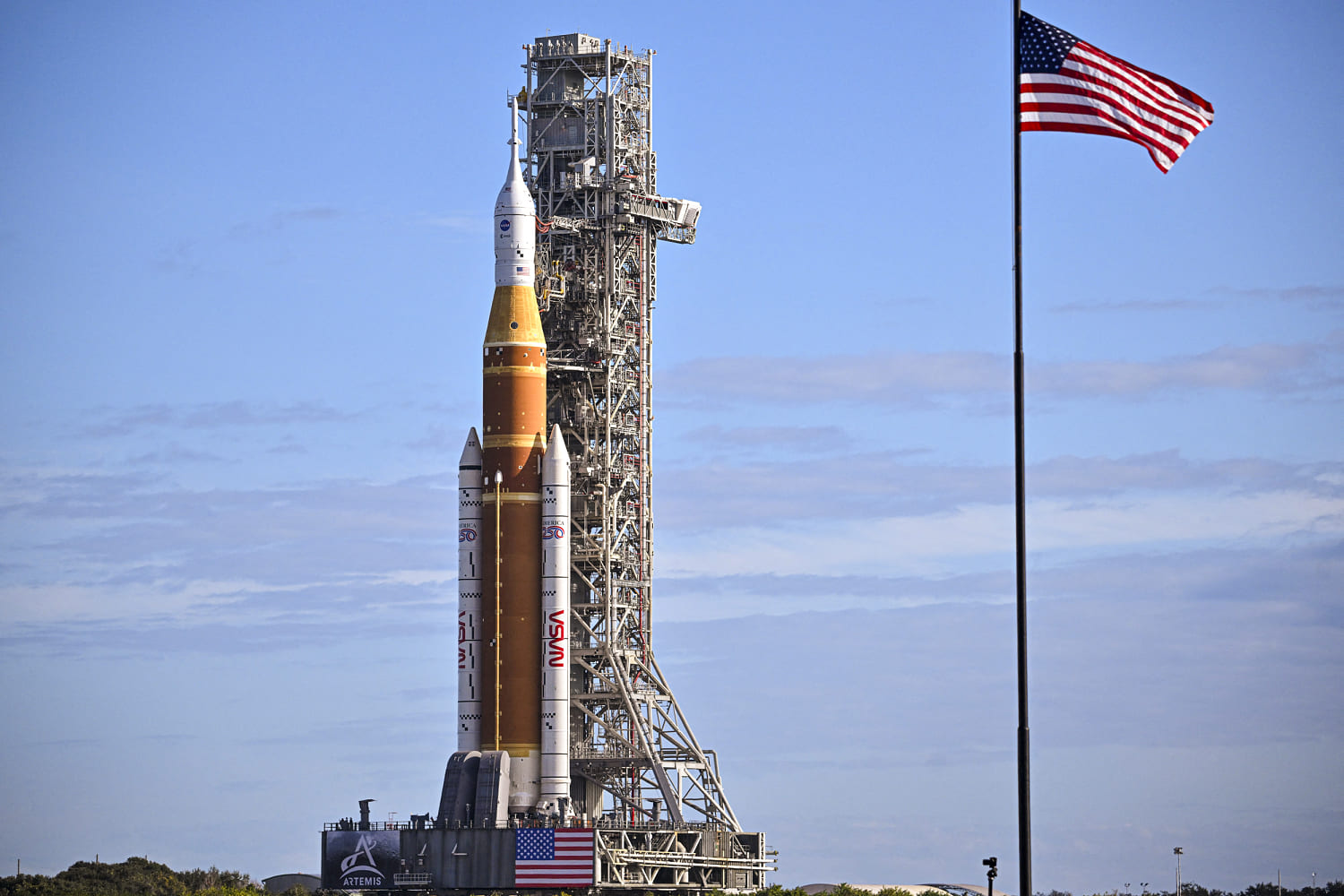
NASA plans to launch four astronauts on a long-awaited trip around the moon as early as April 1, the agency announced Thursday.
Lori Glaze, acting associate administrator of NASA’s Exploration Systems Development Mission Directorate, said teams are on track to roll the Space Launch System rocket and Orion spacecraft back to the launch pad at Florida’s Kennedy Space Center on March 19.
“Everything is going pretty well,” Glaze said in a news briefing.
The targeted launch date of April 1 will depend on remaining work that needs to be completed on the rocket while it’s in the hangar, and subsequent work at the launch pad.
The decision came after mission managers and top NASA officials gathered for two days for what’s known as a flight readiness review, a meeting the agency uses to formally certify a rocket and spacecraft for flight.
The mission, called Artemis II, will be the first time that NASA’s Space Launch System rocket and Orion capsule carry people. On the 10-day voyage, the crew members — NASA astronauts Reid Wiseman, Christina Koch and Victor Glover and Canadian astronaut Jeremy Hansen — are expected to circle the moon, traveling farther from Earth than any humans have gone before.
The 322-foot-tall Space Launch System rocket has been in its hangar for repairs since NASA rolled it back from the launch pad on Feb. 25.
The move followed a key fueling test on Feb. 19, known as a “wet dress rehearsal,” in which NASA practiced almost every step of a simulated launch countdown. Although that rehearsal was successful, engineers later discovered a blockage in the flow of helium to part of the rocket’s upper stage. That prompted NASA to roll it back for repairs, which meant foregoing any launch opportunities in March.
Engineers recently replaced a seal responsible for the blockage, and NASA teams also installed fresh batteries on the rocket and Orion spacecraft and tested various systems on the booster.
The wet dress rehearsal was NASA’s second attempt to fully load the Space Launch System rocket with more than 700,000 gallons of cryogenic propellant. A first wet dress rehearsal on Feb. 2 was cut short after engineers uncovered a different issue: leaking hydrogen fuel from the tail end of the rocket. That problem forced NASA to rule out the available launch opportunities in February.
NASA previously launched the rocket on an uncrewed flight around the moon in 2022 — the Artemis I mission. That flight was delayed six months because of hydrogen leaks.