TOKYO — Asian shares have rebounded from their sharp declines a day before after a rally on Wall Street as global investors wagered that the war with Iran may not last too long.
But the gains early Tuesday fell far short of losses Monday, when oil prices neared $120 per barrel before falling back to about $90. U.S. futures were trading about 0.4% lower.
Helping to assuage investors’ fears, U.S. President Donald Trump told CBS News he thinks “the war is very complete, pretty much.” However, he made other comments that seemed to threaten intensified action against Iran if it makes any “attempt to stop the globe’s oil supply.”
Japan’s benchmark Nikkei 225 added 3.2% to 54,399.08 after the government released revised economic data that showed Japan’s economy grew slightly faster than initially estimated in the final quarter of last year, boosted by solid business investments.
The economy expanded at an annual pace of 1.3%. The initial estimate was a much weaker 0.2%.
“Today is the rebound, obviously positive comments from President Trump overnight, we’re starting to see the light at the end of the tunnel for the war,” said Neil Newman, a managing director and head of strategy at Astris Advisory Japan.
“So volatility is going to remain with us but things are certainly looking a lot brighter today.”
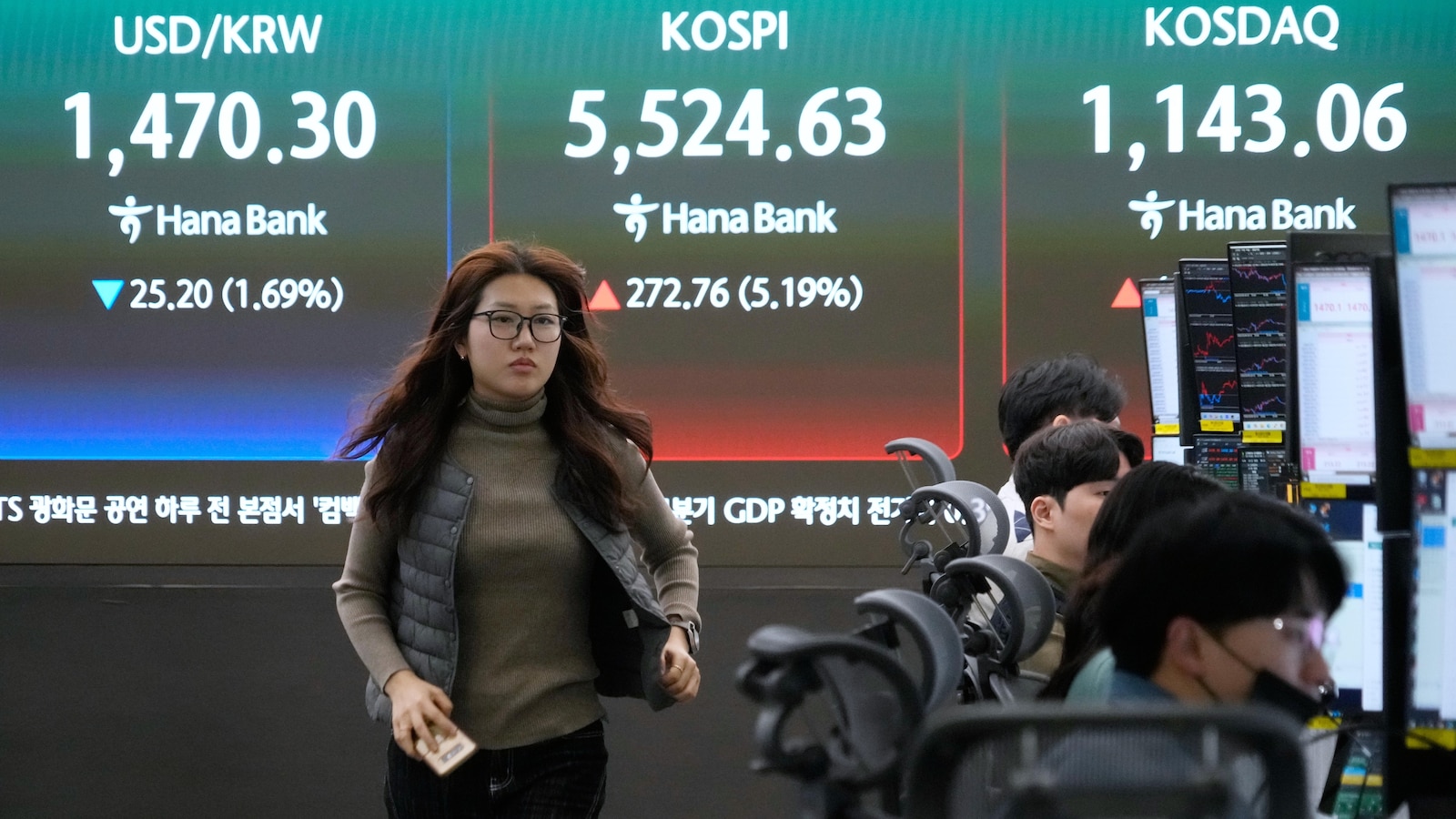
Australia’s S&P/ASX 200 gained 0.8% to 8,669.50. South Korea’s Kospi jumped 3.6% to 5,453.45.
Hong Kong’s Hang Seng added 1.6% to 25,804.70, while the Shanghai Composite index rose 0.4% to 4,119.29.
Share prices have been swinging mostly in tandem with oil prices, which have gyrated as the war has deepened.
Early Tuesday, benchmark U.S. crude fell $4.70 to $90.07 a barrel. Brent crude, the international standard, dipped $5.13 to $93.83 a barrel.
On Monday, stock prices swerved from a steep early loss to a moderate gain. The S&P 500 dropped as much as 1.5% before flipping to a gain of 0.8%. It closed at 6,795.99.
The Dow Jones Industrial Average clawed back a plunge of nearly 900 points to rise 239 points, or 0.5%, to 47,740.80. The Nasdaq composite climbed 1.4% to 22,695.95.
Share prices have wavered due to uncertainty about just how high oil prices will go and how long they will stay there because of disruptions to Middle East energy facilities.
If oil prices stay very high for very long, households’ budgets already stretched by high inflation could break under the pressure. Companies would see their own bills jump for fuel and to stock items on their store shelves or in their data warehouses. It all raises the possibility of a worst-case scenario for the global economy, “stagflation,” where growth stagnates and inflation remains high.
Concerns have focused in particular on the Strait of Hormuz, a narrow waterway off Iran’s coast that a fifth of the world’s oil sails through on a typical day. Iran has threatened to set fire to ships sailing the strait.
If the strait remains closed for only a few weeks, the price of oil could push to $150 per barrel of higher, according to oil and gas strategists at Macquarie Research. Trump also added that when it comes to the Strait of Hormuz, he’s “thinking about taking it over,” according to CBS.
In the bond market, the yield on the 10-year Treasury fell to 4.10% from 4.15% late Friday.
Worries about high inflation and oil prices are pushing upward on Treasury yields, and the 10-year yield briefly rose above 4.20% early Monday. Yields then slid late in the day when oil prices eased.
In currency trading early Tuesday, the U.S. dollar edged up to 157.85 Japanese yen from 157.67 yen. The euro cost $1.1611, down from $1.1638.
___
AP Business Writer Stan Choe in New York and AP Videographer Ayaka McGill in Tokyo contributed.