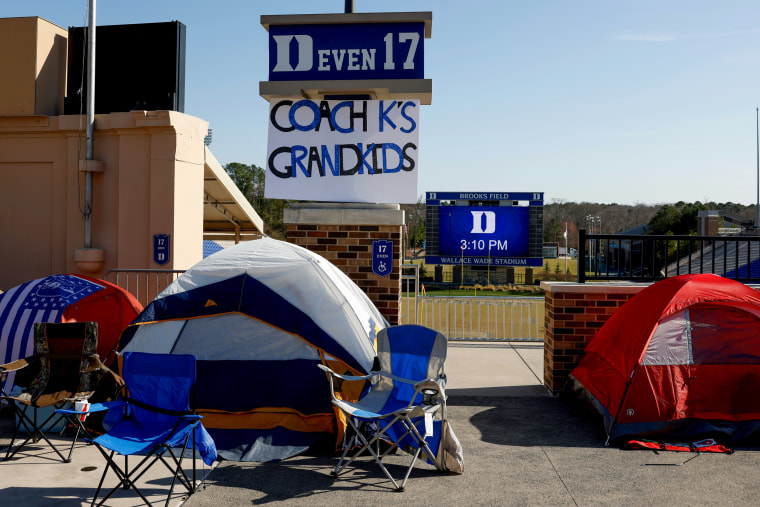
At Duke University, there’s one exam students spend weeks studying for — and still consistently fail. But this test has nothing to do with engineering or science. Instead, they must prove their knowledge of the subject that reigns supreme on campus: basketball.
Follow along for live coverage of Friday’s games
The questions start simple.
- List every current Duke Men’s Basketball player’s jersey number, position, and hometown.
Then they quickly escalate.
- According to Cooper Flagg’s mom Kelly, what time was he born? Bonus: What time was his brother, Ace, born?
- What color dress did Neal Begovich’s date wear to his senior prom?
- According to her LinkedIn, what month of what year did Kyle Filipowski’s girlfriend’s American Red Cross certification expire?
Duke is currently the top overall seed in the NCAA Tournament, and just survived a first-round scare against No. 16 Siena, winning 71-65 on Thursday. The Blue Devils’ roster is full of NBA-caliber talent like freshman star Cameron Boozer, a potential No. 1 draft pick. But they’re also powered by the Cameron Crazies, as the school’s student section is known, one of the most dedicated fan bases in the country.
How dedicated are they? Look no further than the “tenting” exam.
Every year, to earn a student section ticket to Duke’s rivalry home game against the University of North Carolina at Chapel Hill, students camp outside Cameron Indoor Stadium for weeks in the dead of winter. But often demand is so high that just camping isn’t enough — hopeful attendees must pass a basketball trivia exam to earn a plot to pitch their tents.
“It’s part of what makes our fans the best in all of college basketball,” Camden Reeves, a Duke senior, said. “The reason the student section is always so wild and invested in games is that it’s a meritocracy. It rewards those who are willing to be the most committed, to sleep in K-Ville the longest or study for the test the hardest.”

K-Ville is the name of the tenting compound, short for “Krzyzewskiville,” named after the legendary Duke coach Mike Krzyzewski, who retired in 2022. In the mid-1980s, early in Krzyzewski’s tenure, the Blue Devils were not yet the national power they are now.
“No one, at least that I was aware of, was camping outside Cameron when I was a student,” NBA Commissioner Adam Silver, who graduated from Duke in 1984, told NBC News. “In fact, there was hardly ever a line to get into the games. A lot has changed.”
On a school night in 1986, Kim Reed — then a Duke senior — sat in a common room with her friends, debating when to line up for that Sunday’s Duke-UNC game. Someone suggested 6 a.m. for the noon tipoff.
But as the night went on, Reed said, “we got progressively more inebriated … until we finally said, ‘Let’s just go now.’ We walked outside all bundled up. It was 28 degrees and sleeting.”
The friend group quickly realized sleeping on the ground outside was untenable. So the next morning, they went to a U-Haul, rented six tents and pitched them outside Cameron.
“Coach K walked by us and looked at us like, ‘What is wrong with you?’” Reed said.
But as the week went on, tents continued to pop up. The friends dubbed the camping ground Krzyzewski-ville and mounted a sign that read, “Don’t even think about cutting this line…We’ve been here since Thursday. We’ll kill you.”

The next year, when Reed returned to campus after graduating, she was stunned.
There were 40 tents outside Cameron.
“We never in a million years thought anybody would do this again,” Reed said. “I thought they were crazy.”
As more tents appeared, the encampment became a lawless land. Jason Evans, an early tenter, remembers waking up one morning to find people who hadn’t been there the night before: “And I was like, ‘These people have jumped ahead of us,’” he said. “This is not appropriate.”
He grabbed a legal pad and started jotting down names, assigning students an order. The following year, in the spring of 1987, the students formalized a system for keeping law and order, designating students to serve as “line monitors.” They would essentially run K-Ville, conducting attendance checks throughout the day and enforcing a strict queue.
Over the next few decades, as Coach K won five national titles and turned Duke into, arguably, the sport’s pre-eminent program, tenting grew increasingly popular. Students began setting up camp earlier and earlier, until some were spending their Christmas breaks sleeping in tents for a spring game, Reed said. That’s when the university stepped in, setting an official start date for tenters.

During the 2018–2019 season — when Duke had future NBA No. 1 overall pick Zion Williamson on its roster — student demand for tickets and tenting in K-Ville had reached such a fever pitch that the line monitors introduced another new requirement: the tenting entrance exam.
Today, there are different tenting tiers — black, blue and white — each with varying start dates and levels of intensity. White tenters spend the least time in their tents, but to secure a spot they must compete in a highly competitive, campuswide scavenger hunt.
Black tenting is the most extreme, and often requires passing the entrance exam. This year, black tenters pitched their tents Jan. 18 for the March 7 Duke vs. UNC game.
To qualify for a black tent, students first team up in groups of 10-12 people. If fewer than 80 groups sign up, no entrance exam is required.
But in high-demand years — like the 2024–2025 season, which featured freshman standouts Cooper Flagg and Kon Knueppel — more than 230 tent groups vied for 70 spots, the Athletic reported. More than a third of the student body signed up for the test.
Suddenly, those who might otherwise ditch their textbooks over winter break start to cram.
“It’s very similar to the energy of taking an SAT,” Duke junior Camille Stecker said.
And for some, the stakes feel that high.
“I’m definitely a big procrastinator, so I’ll wait until one or two days before a big exam for my actual academic classes to start studying,” Reeves, the Duke senior, said. “But it’s funny to think I was studying for that tenting test three weeks in advance.”
Preparation methods are what you’d expect from college kids: Quizlets, flashcards, library study sessions. But this particular test also requires serious social media sleuthing, memorizing statistics and rewatching games.
“There were a lot of 10-hour study days,” said Anmol Sapru, a Duke senior who helped craft a study guide with more than 100 sections. “I probably worked harder on studying for this exam than any other exam this semester.”
The line monitors administer the exam with near-total secrecy. To prevent leaks, only two monitors ever see the final questions.

Aida Anderson, who co-wrote the exam in 2023 and 2024, said she spent months crafting questions — some straightforward, others less so. Some questions are so difficult, the most die-hard Duke fan might struggle.
“As a student, I would have taken it ‘pass/fail,’” Silver told NBC News. “Today, I’d probably get a C.”
“I would probably do terrible. It’s crazy,” Kyle Filipowski, Duke’s leading scorer from 2022 to 2024 who now plays for the Utah Jazz, told NBC News. And he’s the subject of some of the questions.
On exam day, students pack into Cameron Indoor Stadium, sitting cross-legged on the hardwood court. Teammates work together to fill out more than a dozen pages of questions before one hour runs out.
It’s the line monitors’ duty to ensure no one even thinks about cheating.
“We make sure everyone with long hair has their hair behind their ears so no one can have an AirPod in,” said McKenna Raley, who served as a line monitor for three years. “All backpacks go against the wall. People’s cellphones have to go in Ziploc bags.”
As teammates debate and collaborate, there’s strategy involved: correct answers accumulate points, but incorrect ones result in a deduction, meaning guessing can hurt more than help.
“The basics were the high schools of every player, their hometowns, their ages, their families, their birthdays,” junior Kemi Diver said. “That was easy stuff. I’ll still never forget that Cooper Flagg’s birthday is Dec. 21, 2006.”
But Diver was heartbroken to learn that guessing cost her group a tenting spot. “We studied very hard, and we actually did really well on it,” she said. “And then with five minutes left, we guessed on all of the questions we did not know… and we nullified our score.”
Top scorers advance to the next daunting task: living in a tent. During the black tenting period, two members of each group must be present during all hours of the day (while others attend classes), but 10 must sleep there every night.
“It’s very crowded,” said Reeves. “You’re shoulder to shoulder like sardines against people.”
Students are sent home when temperatures dip below 32 degrees Fahrenheit, but they still face all of the elements: snow, mud, rain and wind.
Diver layered three pairs of socks and placed hand warmers on her nose to keep warm overnight.
As the wind whips, many tents blow over and collapse. And rain adds another layer of challenges: “If you leave the tent a little unzipped for one day, every single item in there is absolutely ruined,” Sapru said.
At random times throughout the night, a bullhorn siren blares. All tenters must scramble into the cold, checking in with a line monitor to prove they’re still there.
“They call a check, you’re trying to run as fast as possible, and sometimes one shoe is missing,” Sapru said. “I’ve carried at least one of my friends this year on my back when they couldn’t find their shoes.”
On so-called “death nights,” the horn sounds once an hour, leaving students struggling through the following day.
“I’d fall asleep in class or just think about falling asleep instead of focusing in class,” Sapru said.

But even amid the restless nights, there are plenty of moments of camaraderie and connection. Diver recalls one night, after a 3 a.m. tent check, her group deliriously began to sing the Backstreet Boys’ “I Want it That Way.” Soon, surrounding tenters were harmonizing with them.
“The mutual suffering experience really brings the group together and helps bond people,” Reeves said. “You get to learn a lot more about people, have great conversations, play games.”
When game day finally arrives, hundreds of tenters pour into Cameron Indoor Stadium. Coated in bright blue body paint and donning outlandish costumes, they pack the student section, standing mere inches from the court. The excitement is so high, the cheers so loud, “you’d think the building’s gonna just tumble down,” Diver said. “It’s deafening.”
After nearly two months of anticipation, it all comes down to two hours.
Some years, the team loses, and students shuffle out in silence. But this year, on March 7, the Blue Devils delivered, beating North Carolina 76-61 as Boozer scored 26 points.
“I don’t know what came over me, but when we won against Carolina, I just started crying,” Reeves said. “You just feel all of the sleepless nights and cold and your feet being wet turning into an amazing product … It’s an experience like nothing else.”
“It’ll be the greatest thing I’ll do for a very long time,” Sapru said. “I would do it four more times if I could.”