U.S. officials face growing concern about Iran war escalating amid energy facility attacks


Ongoing Iranian attacks on oil and gas facilities around the Persian Gulf on Thursday escalated the war’s effects on global energy supplies, as President Trump rebuked Israel for striking a key Iranian gas field, and other nations voiced growing fears that the conflict would spin out of control.
Saudi Arabia said it might respond with force if Iran continues to attack facilities in the kingdom, and the price of oil once more skyrocketed.
Trump said Israel acted “out of anger” and without the knowledge of the U.S., when it attacked the “extremely important and valuable” South Pars Field, the world’s largest natural gas field. Writing on social media, Trump said there would be “NO MORE ATTACKS” unless Iran continues to strike liquefied natural gas fields in Qatar.
If Iranian attacks continue, however, the U.S. would “massively blow up the entirety of the South Pars Gas Field at an amount of strength and power that Iran has never seen or witnessed before,” Trump wrote.
The president’s remarks came as Iran’s intensifying attacks on Gulf energy infrastructure further rattled and angered America’s allies in the region and sent shock waves through the global economy. The price of Brent crude oil, the international standard, rose to as high as $118 a barrel — or up more than 60% since the start of the conflict.
The strikes further threatened a global energy supply already eroded by Iranian attacks on ships in the Strait of Hormuz, through which a fifth of the world’s oil is normally transported.


Despite repeated assurances from Trump and other U.S. leaders that the U.S. is rapidly wiping out Iran’s mine-laying, missile and drone capabilities in the region, Iranian attacks have continued on the vital waterway — with one vessel set ablaze Thursday off the coast of the United Arab Emirates and a second damaged off Qatar.
On the other side of the Arabian Peninsula, a Saudi refinery on the Red Sea designed to bypass the strait was hit by an Iranian drone.
The strikes also added to uncertainty around the Trump administration’s grasp on the conflict’s trajectory, scope and timeline.
In recent days, Trump has made contradictory comments on the strait. He asked allies to help safeguard the strait but then said the U.S. didn’t the help — after allies rebuffed his pleas.
On Thursday, he reiterated that message during an event with Japanese leaders at the White House, saying it would be “appropriate” for European countries, Japan and other U.S. allies to help defend the strait, but unnecessary. “We don’t need anything,” he said.
Secretary of Defense Pete Hegseth, in earlier remarks Thursday, doubled down on the administration’s repeated claims that the war is going perfectly according to plan, and that the U.S. is at no risk of entering into another “endless war” or Middle East quagmire.
Hegseth said U.S. officials “wouldn’t want to set a definitive time frame” on wrapping up the war, adding that the American people should disregard all the “noise” about the conflict “widening.”
But, he spoke as that noise was growing into a chorus in the face of the latest Iranian strikes.
French President Emmanuel Macron, speaking ahead of a European Union summit, condemned what he called a “reckless” escalation of the conflict and urged negotiations.
Arab League Secretary-General Ahmed Aboul Gheit called the Iranian attacks on Gulf infrastructure a “dangerous escalation.” Authorities in Abu Dhabi in the UAE used the same phrase to describe Iran’s overnight attacks on some of their energy facilities.
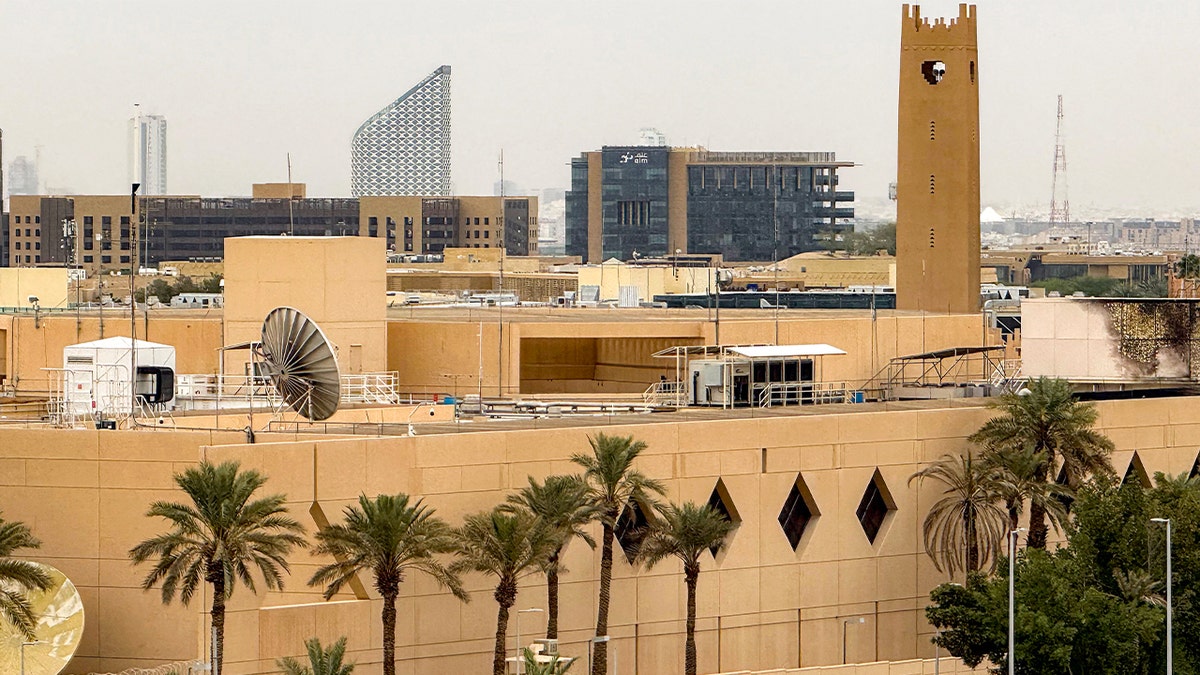
Saudi Foreign Minister Prince Faisal bin Farhan said Thursday that trust between his government and Tehran “has been completely shattered,” adding that Riyadh “reserves the right to take military action if necessary.”
“The kingdom and its partners possess significant capabilities, and the patience we have shown is not unlimited,” he said after a meeting of foreign ministers in Riyadh. He did not specify when that patience would run out.
The kingdom’s air defenses have intercepted at least 457 drones, 40 ballistic missiles and seven cruise missiles since the U.S. and Israel attacked Iran on Feb. 28. In that same time, the UAE downed 1,714 drones, 334 missiles and 15 cruise missiles, according to Emirati officials.
In Qatar, the state-owned QatarEnergy said a blaze at the Ras Laffan LNG facility — the largest LNG export facility in the world, where production had already been halted — ignited after a strike by Iranian missiles, and had caused “extensive” damage.
In Kuwait, the Mina Al-Ahmadi refinery — one of the biggest in the Middle East — and the nearby Mina Abdullah refinery both caught fire after drone attacks, officials there said.
In Israel, millions of people rushed to shelters as more than a half-dozen waves of Iranian attacks targeted large parts of the country.
Meanwhile, Hegseth said that the U.S. was gearing up to deliver its “largest strike package yet” on Iran on Thursday. He said the military would be asking for billions more from Congress to continue waging the war because “it takes money to kill bad guys.”
The Reuters news agency on Wednesday reported that the Trump administration is considering deploying thousands of U.S. troops to Iran, citing four anonymous sources.
In response, a White House official told The Times that there has been no decision to send ground troops to Iran, but that Trump is keeping all of his options open to achieve his goals in Iran, including destroying its ballistic missile capabilities and guaranteeing that it cannot develop a nuclear weapon.
The U.S. took steps Thursday to stabilize the oil market.
Treasury Secretary Scott Bessent announced that the U.S. may soon remove sanctions from approximately 140 million barrels of Iranian oil currently “on the water” in tankers, which he said should inject supply into the market and curb price spikes. “Depending on how you count it, that’s 10 days to two weeks of supply,” Bessent said.
The administration is also weighing another unilateral release from the U.S. Strategic Petroleum Reserve to further depress prices, as U.S. reserves fall to their lowest levels since the 1980’s.
Were sanctions to be removed, it would serve as a massive financial lifeline to the Iranian government, enabling Tehran to reap billions in revenue that it could use to fund its ongoing fight against the U.S. and Israel.
Iran, in turn, threatened additional retaliation if their energy infrastructure is further attacked — with a spokesperson from the Islamic Revolutionary Guard Corps saying the response to future attacks would be “far more severe.”
“We warn the enemy that you made a major mistake by attacking the energy infrastructure of … Iran,” said the spokesperson in a statement carried by the Iranian ISNA news agency.
“If it is repeated again, the next attacks on your energy infrastructure and that of your allies will not stop until their complete destruction,” the statement said.
The New York-based Soufan Center, in a research note, said that Israel’s strike on South Pars — which directly threatened Iran’s electricity supplies — marked a “clear expansion of the conflict.”
“Israel’s target selection in this war has heavily focused on the institutions, leaders and infrastructure,” the think tank said. “It now seeks to inflict additional pressure on the regime by making the living conditions for civilians intolerable.”
Amid the tensions, Gulf leaders have also expressed growing dissatisfaction with Washington.
On Wednesday, Oman’s foreign minister Badr Albusaidi, a central figure in the negotiations between the U.S. and Iran, described the war as a “catastrophe,” and said the Trump administration’s “greatest miscalculation” was “allowing itself to be drawn into this war in the first place.”
Albusaidi added Iran’s retaliation against Gulf states “was an inevitable, if deeply regrettable and completely unacceptable, result,” that “was probably the only rational option available” to an Iranian leadership facing an existential war.
“America’s friends have a responsibility to tell the truth,” he said. “This is an uncomfortable truth to tell, because it involves indicating the extent to which America has lost control of its own foreign policy. But it must be told.”
Rector reported from Colorado and Bulos from Beirut. Staff Writer Gavin J. Quinton contributed to this story.