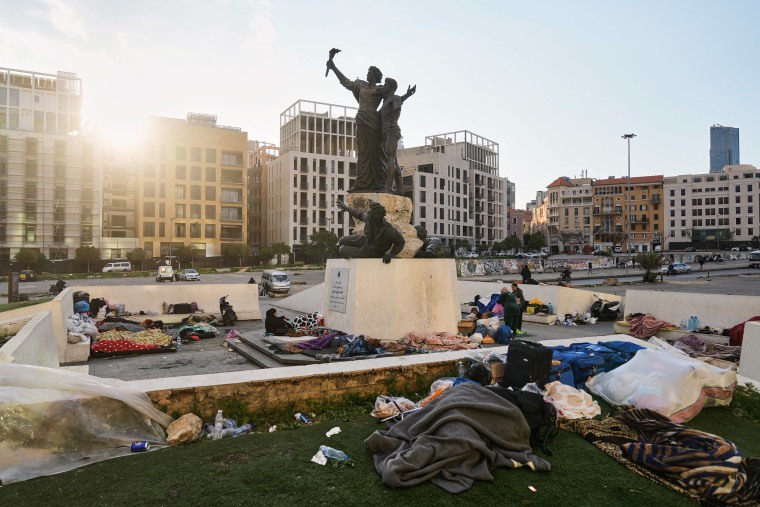
A humanitarian crisis is looming in Lebanon where more than 750,000 people have been displaced in the 12 days since the U.S. and Israel began their war with Iran and its proxies in the Middle East, figures released by the Lebanese government show.
The pace of displacement was “unprecedented,” along with the “panic, also, that this has all created,” Imran Riza, the United Nations humanitarian coordinator in Lebanon, told Reuters on Tuesday. More than 100,000 people were registered as displaced between Monday and Tuesday alone, the data showed.
The majority come from Lebanon’s south, where the Israeli military has enforced sweeping evacuation orders while launching multiple strikes on the region, a stronghold of the militant group Hezbollah. The U.S. military has not struck Lebanon.

The Israeli military said Tuesday that it was “operating with determination” against Hezbollah after the Tehran-backed group launched missiles at Israel in what it said was retaliation for the joint U.S.-Israeli war on Iran.
Since the start of the war Feb. 28, more than 570 people have been killed and around 1,400 injured as of Tuesday, according Lebanese government figures. Scores of children are among the dead, according to UNICEF.
Sleeping on streets
The numbers “are really shocking because they really jump so high,” Dr. Tania Baban, the Lebanon country director for the Chicago-based nonprofit MedGlobal, told NBC News in a telephone interview Wednesday.
Baban said part of the rapid rise in the number of people identified as being internally displaced was likely due to the recent release of an online platform allowing people to formally register with the government as having been displaced.

The overall total was likely higher than 750,000, given that not everyone will have been able to access the platform, she added.
While the data showed just more than 120,000 people were listed as being housed in shelters set up across the country, Baban said many were sleeping in tents on the streets of Beirut or in parked cars.

“People who have bigger cars are more fortunate,” she said, adding that she had come across one father sleeping out “on a chair on the pavement” while his family, including four children, slept in their car.
Some were deciding not to move to shelters in northern Lebanon and opting to stay in Beirut so they could remain closer to their homes in the south, she said.
Riza, at the United Nations, told Reuters that the majority of the million or so people displaced in Lebanon during the war between Israel and Hezbollah in 2024 did not go to collective shelters. That would likely be the case during the current hostilities consuming the region, he added.
“There are about 100,000 people that are, as of this morning, in some 477 collective shelters. There are some 57 shelters that still have some space, but basically the capacity is being reached very, very quickly,” he said, with churches and Beirut’s Sport’s City Stadium converted into shelter sites.

Baban said humanitarian groups on the ground were also hearing of local municipalities seeking to discourage residents from renting homes to displaced people coming from the south over fears their areas could be targeted if suspected Hezbollah members were among them.
The sweeping displacement and growing death toll in Lebanon come as Human Rights Watch issued a report this week accusing the Israeli military of illegally using white phosphorous munitions over homes in the southern Lebanese town of Yohmor on March 3.
It said it had verified at least eight images appearing to show white phosphorus used over a residential area of the town and civil defense workers responding to fires.

“The incendiary effects of white phosphorus can cause death or cruel injuries that result in lifelong suffering,” Ramzi Kaiss, Lebanon researcher at Human Rights Watch, warned in a statement Tuesday.
The Israeli military said in a statement Wednesday it was “currently unaware and cannot confirm use of shells that contain white phosphorous in Lebanon as claimed.” While its primary smoke shells do not contain the substance, it said some of them did contain “a certain amount,” which “are lawful under international law.” These were used to create smoke screens and were not used for targeting or causing fire, it added.
Elsewhere, the French Foreign Ministry called for an emergency meeting of the U.N. Security Council to be held Wednesday to discuss the growing humanitarian crisis unfolding in Lebanon. It said in a statement Tuesday that it was it was “deeply concerned by the current displacement of civilians.”
It also called on Israel to “refrain from any land-based or long-term interventions in Lebanon” as it condemned Hezbollah for launching attacks on Israel amid the wider war.