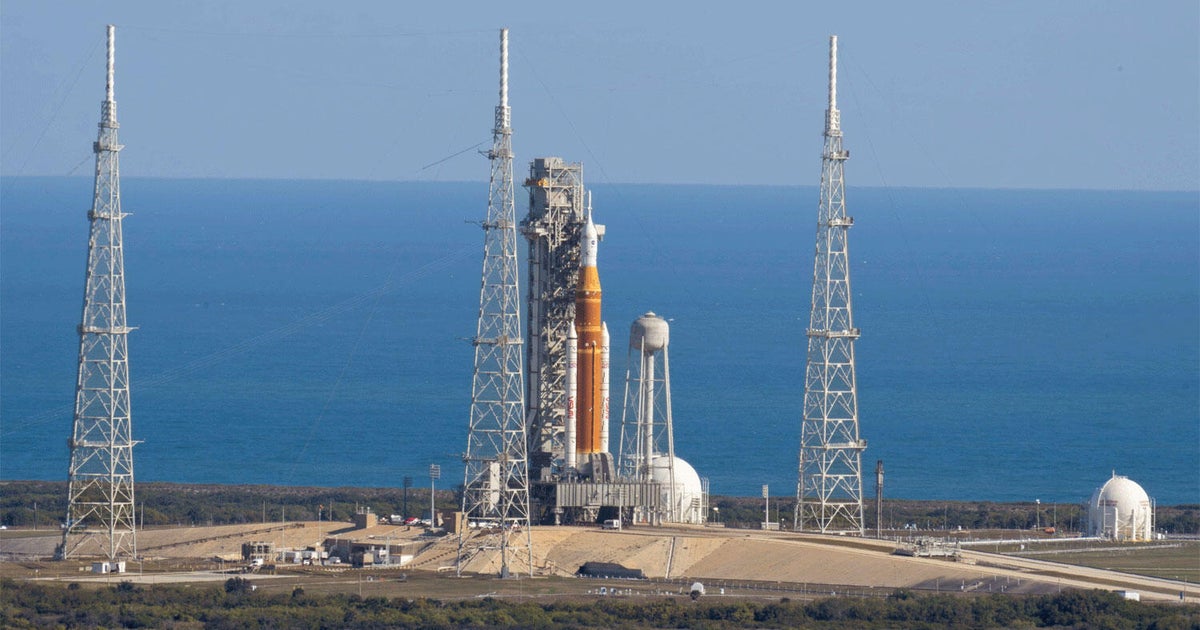
Grounded until at least April, NASA’s giant moon rocket is headed back to the hangar this week for more repairs before astronauts climb aboard.
The space agency said Sunday it’s targeting Tuesday for the slow, four-mile trek across Kennedy Space Center, weather permitting.
“The quick work to begin preparations for rolling the rocket and spacecraft back to the VAB (Vehicle Assembly Building) potentially preserves the April launch window, pending the outcome of data findings, repair efforts, and how the schedule comes to fruition in the coming days and weeks,” the space agency said in a statement on Sunday.
NASA had barely finished a repeat fueling test Thursday, to ensure dangerous hydrogen fuel leaks were plugged, when another problem cropped up.
This time, the rocket’s helium system malfunctioned, further delaying astronauts’ first trip to the moon in more than half a century.
Engineers had just tamed the hydrogen leaks and settled on a March 6 launch date — already a month late — when the helium issue arose. The helium flow to the rocket’s upper stage was disrupted; helium is needed to purge the engines and pressurize the fuel tanks.
“Returning to the Vehicle Assembly Building at Kennedy is required to determine the cause of the issue and fix it,” NASA said in a statement.
NASA said the quick rollback preps preserve an April launch attempt, but stressed that will depend on how the repairs go. The space agency has only a handful of days any given month to launch the crew of four around the moon and back.
The Artemis II mission aims to send four astronauts — Reid Wiseman, Victor Glover, Christina Koch and Canadian astronaut Jeremy Hansen — on a flight around the far side of the moon and back to thoroughly test the agency’s Orion deep space capsule to help clear the way for a lunar landing mission, Artemis III, in 2028.
The crew members were released from quarantine on Saturday and remain in Houston, NASA said in a statement. They will become the first people to fly to the moon since NASA’s Apollo program that sent 24 astronauts there from 1968 through 1972.