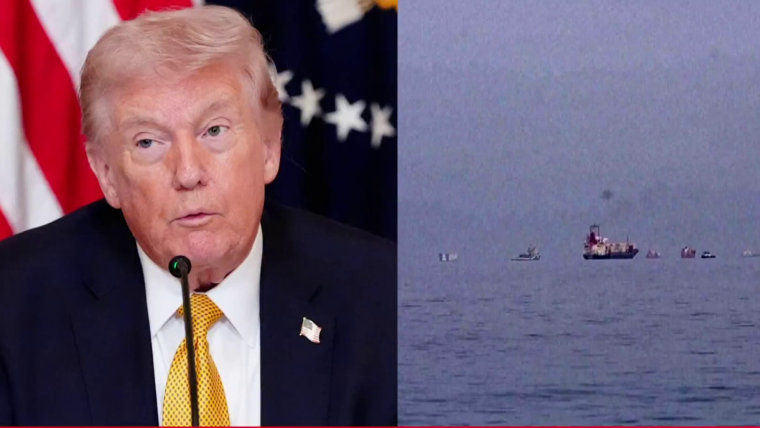
WASHINGTON — President Donald Trump dropped his push Tuesday for U.S. allies to join in protecting the Strait of Hormuz from Iranian threats — an about-face that came just one day after he called upon nations to “get involved” so oil tankers can safely navigate the crucial shipping lane.
First on social media and later in an Oval Office meeting, Trump said the outside military support he has been working to muster is no longer necessary in the war, which the U.S. and Israel launched against Iran on Feb. 28.
“We don’t need any help, actually,” Trump said in an exchange with reporters in the Oval Office as he hosted Ireland’s prime minister, Micheál Martin.
The White House didn’t immediately reply to a request for additional comment.
Trump had gotten a chilly response from U.S. allies he’d tried to enlist in a joint effort to police the strait, which has been effectively shut down in the face of Iranian attacks that have jeopardized oil supplies.
On Monday, German Defense Minister Boris Pistorius said, “This is not our war; we have not started it.” Before Trump’s Oval Office meeting Tuesday, French President Emmanuel Macron said his country would “never take part in operations to open or free the Strait of Hormuz in the current context” but was prepared to play a role once the fighting stopped.
Asked about Macron’s statement, Trump said he “will be out of office very soon.” (Macron’s term ends in May 2027.)
Trump was measured in discussing the dustup within the NATO alliance, though one of his confidants, Sen. Lindsey Graham, R-S.C., wrote on X that he had spoken to Trump about it and had “never heard him so angry in my life.”
“The repercussions of providing little assistance to keep the Strait of Hormuz functioning are going to be wide and deep for Europe and America,” Graham wrote, saying he shared Trump’s anger.
Trump had talked repeatedly in recent days about assembling a coalition that would help repel Iranian attacks against oil tankers and other ships navigating the strait, a narrow passageway that has become a choke point for the world’s oil.

The war has triggered a spike in gas prices, creating political problems for Trump at home ahead of the congressional midterm elections in November.
Trump said Monday at the White House that “numerous countries have told me they are on their way” to help. He said Secretary of State Marco Rubio would be making an announcement. No announcement or list has yet been released.
As for the holdouts, he said, “we strongly encourage the other nations to get involved with us and get involved quickly and with great enthusiasm.”
The Iran war amounts to a test of Trump’s “America First” approach to global conflict. He has long been skeptical of military alliances, warning that the U.S. builds a protective umbrella around other nations without any guarantee that those beneficiaries of American power would come to its aid when needed.
That position has alienated NATO countries that have sent troops to U.S.-led wars in Iraq and Afghanistan, only to see them die in action.
The one time NATO invoked the Article 5 mutual security guarantee was in defense of the U.S. following the terrorist attacks on Sept. 11, 2001.
“Trump’s bullying and tendency to negotiate by megaphone don’t go down well with European allies,” Peter Westmacott, a former British ambassador to the U.S., told NBC News.
In 1990-91, President George H.W. Bush knitted together a broad coalition of nations to confront Saddam Hussein, the Iraqi dictator, before he launched Operation Desert Storm.
By virtue of Bush’s painstaking diplomatic work, that conflict “became, literally, Saddam Hussein against the world,” said Aaron David Miller, a former State Department official and now a senior fellow at the Carnegie Endowment for International Peace.
No such consultations took place before the U.S.-Israeli attack on Iran, various diplomats said.
Some coalition-building efforts are unfolding now, more than two weeks after the strikes started. In a State Department-wide cable Monday, all U.S. diplomats were directed to tell foreign governments, “at the highest appropriate level,” that they “must move expeditiously to diminish the capabilities of Iran” because of an “elevated risk of attack” on their own countries.
A European diplomat told NBC News: “He’s asking us to help for a war he started. There is not much enthusiasm for this. And even if European navies are sent to the Gulf, it would not ensure the strait is reopened. Iran can keep it closed as long as it likes because all it takes is a drone or a mine.”
In the run-up to “Operation Epic Fury,” Trump ignited a series of confrontations with NATO countries that have soured relations on both sides of the Atlantic. Trump rattled U.S. allies with his focus on acquiring Greenland, a semiautonomous territory of Denmark.
For a time, he wouldn’t rule out using force, if necessary, but then he backed off in favor of a negotiated solution to Greenland’s status.
“It’s not possible to just forget what happened with Greenland. Trust has been damaged, and it’s not easily repaired,” said a second European diplomat.
Trump also has confounded European allies by not using more coercive sanctions to pressure Russian President Vladimir Putin to get him to make peace with Ukraine. More than two months ago, Graham said that Trump had “greenlit” a bipartisan bill that would have imposed tougher sanctions on Russia and that a Senate vote could happen in a week. The measure is still languishing in Congress.
The Trump administration appears to have moved in the opposite direction, temporarily lifting sanctions last week against Russian oil that was at sea, in hope of boosting supplies and curbing prices.
Trump told NBC News that Ukrainian President Volodymyr Zelenskyy has been “far more difficult to make a deal with” than Putin in ending the war.
Those comments unnerved current and former officials at home and abroad. A former senior U.S. military officer said they were incredulous that Trump would place blame on Zelenskyy, whose democratic country was invaded by Russian forces. A third European diplomat said they were upset that Trump saw fit to criticize Zelenskyy, as opposed to Putin. Both spoke on condition of anonymity to talk freely.
Marko Mihkelson, who chairs the Estonian Parliament’s Foreign Affairs Committee, told NBC News: “If President Trump would like to achieve peace — as he has promised and worked for — then he has to change tactics against Russia. You can’t be a neutral mediator in this war. Russia is not going to stop unless they are stopped.”
Added Westmacott: “On Ukraine, Trump has been a huge disappointment to America’s European allies. They are dismayed by his tendency to believe the lies Putin tells him, to see Ukraine as a purely European issue and to depict Zelenskyy as the obstacle to peace when Europeans, and the facts, show the opposite to be the case.”
It’s unclear whether the position Trump laid out Tuesday will hold. By his own acknowledgment, he hadn’t made a “full court press” for additional help.
Differences aside, America and its European allies need to recognize the stakes and accept that their interests are aligned, Mihkelson said.
“Europeans must understand that to succeed in this very turbulent world today and to safeguard our security and stability, we have to stick together,” he said.