Scott Adams, ‘Dilbert’ cartoonist and author who pushed on through cancellation, dies at 68

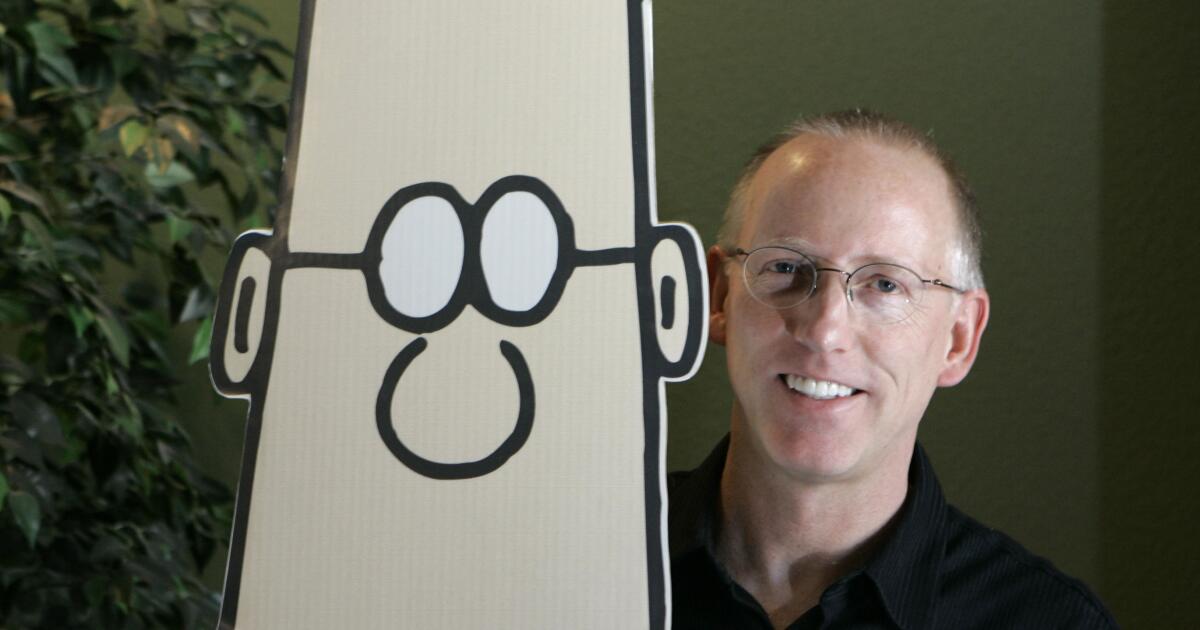
Scott Adams, whose comic strip “Dilbert” satirized a certain kind of workplace culture for more than 30 years before its author was canceled because of his comments on race, died Tuesday morning after a battle with metastatic prostate cancer. He was 68.
The announcement came via Adams’ YouTube channel, where he livestreamed daily until Monday morning.
“Hi everyone. Unfortunately this isn’t good news. Of course he waited until just before the show started, but he’s not with us anymore,” his ex-wife, Shelly Adams, said through tears Tuesday morning.
The cartoonist, whose extremely dry humor and heterodox political beliefs were on public display in recent years on his daily livestream “Coffee With Scott Adams,” spoke directly to his audience almost up to his death, getting some help from friends in his final days. .
Adams revealed his Stage 4 cancer diagnosis in May 2025, shortly after former President Biden’s metastatic prostate cancer diagnosis went public.
“Some of you have already guessed, so this won’t surprise you at all, but I have the same cancer Joe Biden has,” he said on his May 19, 2025, livestream. “I also have prostate cancer that has also spread to my bones, but I’ve had it longer than he’s had it. Well, longer than he’s admitted having it.”
He noted that he and the former commander in chief both had “the bad kind” of prostate cancer.
“There’s something you need to know about prostate cancer,” he said. “If it’s localized and it hasn’t left your prostate, it’s 100% curable. But if it leaves your prostate and spreads to other parts of your body … it is 100% not curable.”
As May, Adams had been using a walker and dealing with terrible pain because, he said, the cancer had spread to his bones. Saying that the disease was “already intolerable,” he added, “I can tell you that I don’t have good days.” He said during a December show that he was “paralyzed” from the waist down in the sense that even though he had sensation, he couldn’t move any of those muscles.
Given all that, he said, “my life expectancy is maybe this summer. I expect to be checking out from this domain sometime this summer.” But Adams outlived that prediction, livestreaming from his hospital bed during a stay for radiation treatment before Christmas and picking up again from his bed at home after that. Each show started off with the “simultaneous sip,” where Adams invited anyone watching to join him in a communal sip from the beverage of their choosing before he launched into reviewing the news of the day.
Born Scott Raymond Adams on June 8, 1957, in Windham, N.Y., to a postal clerk father and a real estate agent mother, he started drawing cartoons when he was 6. Adams was valedictorian at Windham-Ashland-Jewett Central School, received his bachelor’s in economics from Hartwick College in Oneonta, N.Y., and then moved to California, where he earned a master’s in business administration at UC Berkeley.
He proceeded to work for years at Crocker National Bank and Pacific Bell, holding the types of generic corporate office jobs his comic strip would use as fodder. While he was at PacBell, he awakened daily before dawn to try to figure out an alternative career. Cartooning won out.
“Dilbert,” which launched in 1989, went from running in a handful of papers to, at its peak, appearing in more than 2,000 outlets in 57 countries and 19 languages. Adams received the National Cartoonists Society’s Reuben Award, the industry’s highest honor, in 1997. Page-a-day “Dilbert” calendars were top sellers for years, with more than 20 million calendars and “Dilbert” books in print.
The comic took satirical aim at a micromanaged white-collar workplace and eventually grew into an empire that included a short TV series (mostly written by Adams), dozens of books and ubiquitous merchandise.
Dilbert, the strip’s surrogate for Adams, interacted with characters including the Pointy-Haired Boss, the boss’ secretary Carol, co-worker Wally, who was trying to get fired so he would get severance, the competent but underappreciated Alice, hardworking but naive intern Asok, the clueless CEO, the evil HR chief Catbert and Dogbert, the smartest dog in the world.
In addition to his numerous comic compilations, Adams’ books included business writing like “How to Lose Almost Every Time and Still Win Big” and “Win Bigly.”
Adams married girlfriend Shelly Miles, a mother of two, in 2006, and the marriage lasted eight years. The two remained friends after their 2014 divorce, with Shelly ultimately reading Scott’s final message to viewers.
In 2018, Adams learned that his stepson Justin, whom he said he had “raised from the age of 2,” was dead of an overdose at 18 after years of battling addiction. Adams fought back tears as he explained in his livestream that Justin’s decision-making abilities had suffered after a head injury sustained in a bike accident when he was 14.
The cartoonist’s political views have been all over the map — he once called himself “a libertarian, minus the crazy stuff.” In 2016, he declared, “I don’t vote and I am not a member of a political party.” More recently he veered toward support for President Trump, whom he considered a great persuader of people.
Then in February 2023, remarks Adams made on his podcast were interpreted as racist, leading to serious consequences in his career.
During a midweek livestream, Adams had riffed off the results of a poll that asked whether people agreed with the statement “It’s OK to be white.” Among Black respondents, 26% disagreed and 21% said they were not sure — a total of 47% who didn’t think it was OK to be white.
(The seemingly innocuous phrase “It’s OK to be white” had been co-opted in 2017 for an online trolling campaign aimed at baiting liberals and the media, the Anti-Defamation League said in a statement at the time. The phrase also has a history of use among white supremacists.)
“If nearly half of all Blacks are not OK with white people … that’s a hate group. And I don’t want anything to do with them,” Adams said in his usual deadpan delivery. “And based on how things are going, the best advice I could give to white people is to get the hell away from Black people. Just get the f— away. Wherever you have to go, just get away. ’Cause there’s no fixing this. This can’t be fixed.”
He continued, still deadpan, “So I think it makes no sense whatsoever, as a white citizen of America, to try to help Black citizens anymore. It doesn’t make sense. There’s no longer a rational impulse. And so I’m going to back off from being helpful to Black America, because it doesn’t seem like it pays off. Like, I’ve been doing it all my life and the only outcome is I get called a racist.”
Within days, amid backlash about Adams’ comments, “Dilbert” was dropped by a number of newspapers, including the Los Angeles Times. Then his syndicator, which had provided “Dilbert” to outlets that published the comic, shed him as a client entirely. And Penguin Random House slammed the door shut when it nixed publication of his book “Reframe Your Brain,” which would have come out that fall, and removed his back catalog from its offerings.
Adams discussed his own cancellation after the fact, saying a few days later on his livestream that he had been using hyperbole, “meaning an exaggeration,” to make a point. He said the stories that reported his comments had used a trick: “The trick is just to use my quote and to ignore the context which I helpfully added afterwards.”
But he said that nobody would disagree with his two main points, which had been to “treat all individuals as individuals, no discrimination” and “avoid anything that statistically looks like a bad idea for you personally.” He also disavowed racists.
Adams wound up self-publishing “Reframe Your Brain” in August 2023 with a dedication that read, “For the Simultaneous Sippers (Thank you for saving me.).”
Even after his excommunication from the mainstream, Adams’ weekday morning livestreams regularly garnered tens of thousands of views on YouTube and were also viewable on Rumble, where the cartoonist had gone to avoid speech restrictions on YouTube at the height of the COVID-19 pandemic.
The description on one of his video accounts read, “If you enjoy learning how to be more effective in life while catching up with the interesting news, this is the channel for you.”


