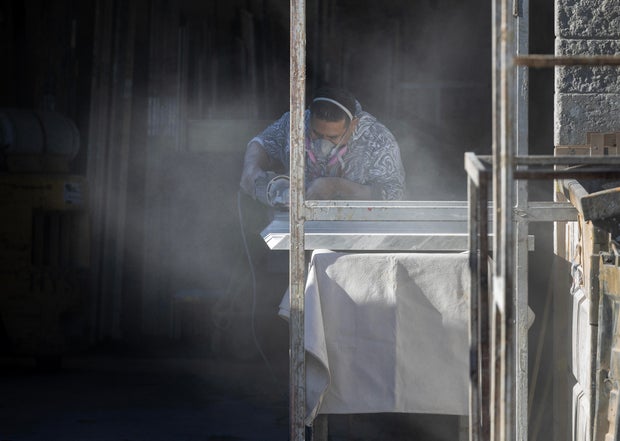
César Manuel González, 37, used to work with stone that was engineered to endure: dense, polished slabs designed to outlast the kitchens in which they were installed.
Engineered quartz countertops have surged in popularity in the home renovation market, with industry analysts estimating the global engineered stone market at around $30 billion. It’s continuing to expand as quartz surfaces replace natural stone in kitchens in the United States and worldwide.
When González was working, the dust that rose from his saw didn’t look extraordinary. It settled on his clothes, in his hair, across the shop floor. In a small countertop fabrication shop, he cut marble and granite before shifting to engineered stone after the 2008-09 recession, when demand for cheaper quartz countertops surged.
But the crystalline silica released while the engineered stone was cut and polished also settled into his lungs, scarring them beyond repair. What began as breathlessness hardened into silicosis, an irreversible disease that stiffens the lungs until even ordinary movement becomes effort.
A lung transplant was his path forward. The procedure can extend survival, but it redraws the boundaries of a life: anti-rejection drugs every day, constant monitoring, vulnerability to infection, the knowledge that breathing depends on the fragile acceptance of another person’s donated organ.
González, who was diagnosed with silicosis in 2023, is not alone in dealing with a disease that once was associated with miners at the end of long careers. It’s now prevalent among the much younger, often Hispanic men who work in this industry, physicians and public health officials say.
Brian van der Brug / Los Angeles Times via Getty Images
In the United States, cases are appearing in countertop fabrication shops from California to Texas, Florida, and the Northeast. Because silicosis is not a nationally reportable disease and surveillance varies by state, no comprehensive national count exists. But clinicians who treat occupational lung disease say the number of workers — often men in their 30s and 40s — diagnosed after cutting engineered stone has risen sharply over the past decade.
As of early March, California had identified 519 confirmed cases of engineered-stone-associated silicosis and 29 deaths since 2019. The median age at diagnosis is 46; at death, 49.
Doctors don’t debate whether working with engineered stone can scar lungs.
Manufacturers argue, though, that proper ventilation, wet cutting, and respirators can make fabrication safe. Workers, physicians, and plaintiffs’ attorneys counter that a material composed almost entirely of crystalline silica may be impossible to handle safely at scale.
“This is comparable to the tobacco industry saying cigarettes are safe,” said Dr. David Michaels, an assistant labor secretary under President Barack Obama who led the Occupational Safety and Health Administration.
More than 370 lawsuits have been filed by workers who say engineered stone manufacturers failed to warn employees about the risks or sold a product that cannot be fabricated safely. At the same time, members of Congress are considering legislation that would largely shield manufacturers from liability in those cases, turning a workplace health crisis into a national debate over regulation, responsibility, and the limits of civil litigation.
Gustavo Reyes, 36, is part of that debate. Like González, he spent the early years of his career cutting marble and granite before shifting to engineered stone, a quartz-based material that can contain up to 95% silica and generates far more hazardous dust when cut.
In the shop, he said, cutting was done with water to control the dust. But finishing work — sanding and shaping — generated heavy dust. He said he wore disposable respirator masks or a reusable elastomeric respirator with filters. A door was kept open. Fans ran overhead.
When he was diagnosed in 2021, he did not know what silicosis meant. The doctor told him that there was no medication and that he had three to five years to live. He received a lung transplant in 2023.
Asked who he believes is responsible, Reyes answered: “The industries who created the artificial stone, the product.” Manufacturers dispute that characterization. Major companies say engineered stone can be fabricated safely when employers follow OSHA dust controls, including wet cutting, ventilation, and respirator use.
An old disease, reengineered
Silicosis is not new. It was synonymous with mining disasters and sandblasting, most notoriously in the Hawks Nest Tunnel tragedy, when hundreds of workers drilling through silica-rich rock in West Virginia in the early 1930s developed acute silicosis after months of unprotected exposure to dust. In 1938, Labor Secretary Frances Perkins advised that the disease could be prevented if dust controls were conscientiously applied.
Themba Hadebe / AP 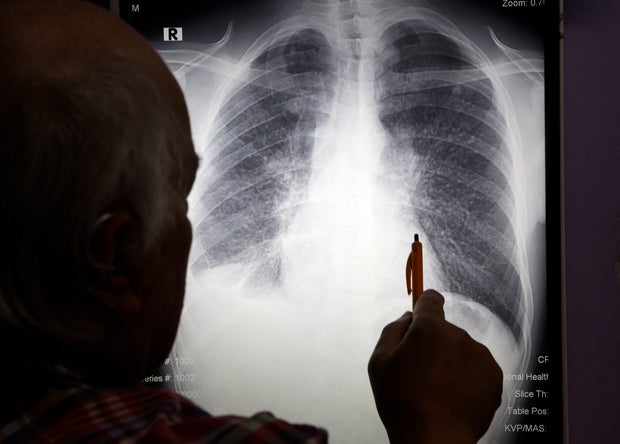
What is new is the industry in which it has resurfaced.
Engineered stone, often marketed as “quartz,” is typically composed of crushed quartz bound with resins and pigments. Unlike marble, which contains little crystalline silica, engineered slabs contain very high levels of the substance.
Cutting changes the material.
“When you grind it, when you cut it, you’re pulverizing it,” said Dr. Robert Blink, an occupational and environmental medicine specialist who treats patients with advanced silicosis in Chicago and is a member of the Western Occupational and Environmental Medical Association. “You’re weaponizing the silica.”
Power tools fracture the surface into respirable particles small enough to lodge deep in the lungs. Repeated exposure triggers inflammation and fibrosis. Once scarring begins, it doesn’t reverse.
What happens when you look for it
In California, physicians say the pattern emerged gradually.
Dr. Robert Harrison, an occupational medicine physician at the University of California-San Francisco, helped identify the first cluster of engineered stone silicosis cases in California in 2019 after several workers from the same countertop fabrication shop died or were diagnosed with the disease. He described the crisis as “the largest outbreak of silicosis in decades.” What initially appeared as isolated cases of unexplained lung scarring in young men resolved into a recognizable occupational epidemic once work histories were examined.
Dr. Jane Fazio, a pulmonologist at UCLA, recalls seeing advanced fibrosis in otherwise healthy workers. “They have families. They were working full-time,” she said. Some experienced respiratory failure within a few years.
When doctors compared work histories, the pattern became unmistakable: Many of the men had worked in small shops cutting and polishing engineered stone countertops.
Brian van der Brug / Los Angeles Times via Getty Images 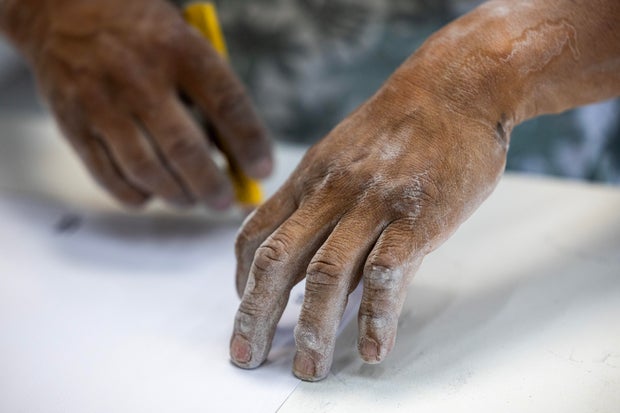
Dr. Sheiphali Gandhi, an occupational and environmental pulmonologist at UCSF, warned that the true burden remains uncertain. “We’re missing cases,” she said. “There’s no national surveillance system for this.”
California designated silicosis a reportable disease in 2025. Since 2019, statewide surveillance has identified hundreds of cases linked to engineered stone. The numbers probably underestimate the toll, though California’s dashboard makes the illness visible.
Outside California, there is no comparable tracking.
Early warnings
California was not the first place this happened.
The earliest modern alarm came from Israel. Caesarstone, a company founded on a kibbutz in the late 1980s, helped popularize quartz countertops globally.
Israeli physicians began documenting aggressive silicosis in young countertop workers as early as 1997.
“We had never seen this before,” said Dr. Mordechai Kramer, a retired pulmonologist who previously worked at Rabin Medical Center in Israel. “In classic silicosis, you expect long exposure, decades. Here, it was much shorter.”
Several patients required lung transplantation.
Despite the warning signs, the market continued to expand.
Australia confronted the same pattern in the late 2010s.
Rather than wait for sporadic diagnoses, Australian regulators launched systematic CT-based screening of artificial-stone workers. Disease prevalence was far higher than anticipated.
Dr. Ryan Hoy, a respiratory physician and occupational health researcher at Australia’s Monash University, described severe disease in workers with relatively short exposures.
Authorities examined whether wet cutting, ventilation, and respirators could reduce exposure sufficiently. They ultimately concluded that even with controls, fabrication of high-silica engineered stone posed unacceptable risk.
In 2024, Australia prohibited the manufacture, supply, and installation of engineered stone containing high levels of crystalline silica. Manufacturers pivoted toward lower- and zero-silica formulations.
In the United States: Who’s to blame?
Fabrication in the U.S. continues under OSHA’s silica standard, which relies on exposure limits, wet cutting, ventilation, and respiratory protection. Manufacturers argue that compliance works and that the problem lies with shops that fail to follow the rules.
OSHA first adopted silica limits in 1971 based on research from mining, quarrying, and foundry work. Although the agency updated the rule in 2016, it regulates crystalline silica broadly and does not distinguish between natural stone and high-silica engineered quartz.
The regulatory debate has now spilled into Congress. The Protection of Lawful Commerce in Stone Slab Products Act, introduced in September by Rep. Tom McClintock (R-Calif.), would largely shield manufacturers and distributors of engineered stone from civil lawsuits arising from the manufacture or sale of their products. McClintock’s office did not respond to a request for comment.
The bill was the subject of a January House Judiciary subcommittee hearing.
Supporters of the measure argue that manufacturers should not be held liable for injuries caused by employers who fail to follow OSHA standards. Opponents warn that removing litigation pressure would eliminate one of the few mechanisms capable of driving product reform if the material itself cannot be safely handled.
Michaels, the former OSHA official, sees the stakes as historical. “Litigation drives change,” he said, pointing to past battles over asbestos and tobacco.
Plaintiffs’ attorneys argue that compliance with the OSHA silica standard does not eliminate risk.
“It’s not a few bad actors,” said Raphael Metzger, a product liability attorney who has filed roughly 200 silicosis-related injury cases and a class action seeking medical monitoring. He said the issue is the product’s composition, not isolated regulatory noncompliance.
James Nevin, a tort attorney representing workers in silicosis cases, framed the congressional debate as a fight over accountability. “When it comes to causation, there’s no question,” he said, arguing that the wave of cases explains why manufacturers are now seeking what he calls “a manufacturer bailout.”
In mid-2025, Caesarstone US introduced its first products containing less than 1% silica. In response to questions, Irene Williams, a spokesperson for Caesarstone, said, “The company is not responding as these are matters of pending litigation.”
The U.S. engineered stone market is dominated by a handful of large brands — including Caesarstone, Spain-based Cosentino, and U.S.-based Cambria — while the volume of slabs imported from Asian manufacturers is growing.
Cosentino, too, is moving to low-silica products: “One third of the portfolio, including most new collections, contain less than 10% of crystalline silica,” said Kamela Kettles, a Cosentino spokesperson. “Cosentino will not be providing additional commentary at this time,” she said.
Commenting on behalf of Cambria, Mark Duffy, a communications consultant for the company, wrote, “Reckless employers are criminally violating the law, exposing workers to deadly working conditions.” He added that engineering and administrative controls, when properly used, are effective in reducing exposures below OSHA limits and said Cambria maintains exposures below the OSHA Action Level in its own facilities.
While Caesarstone and Cosentino are headquartered overseas, Cambria is based in Minnesota. Its chief executive, Marty Davis, has been a major Republican political donor, contributing millions of dollars to President Donald Trump’s election campaigns as well as to other Republican candidates and political action committees, according to federal campaign finance records. Davis has also contributed to the campaign of Rep. Brad Finstad (R-Minn.), a co-sponsor of the legislation. Finstad’s office did not respond to a request for comment.
Nevin, the attorney, said the bill would give manufacturers “free rein” from civil liability.
He also questions whether regulatory enforcement alone can address the problem. Even before the Trump administration’s funding and staffing cuts, “you had a better chance of being struck by lightning than being visited by OSHA,” he said, arguing that inspections are too infrequent to prevent disease in an industry composed largely of small shops.
Breathing on borrowed time
For González, the debate arrives after the fact. The dust he inhaled has already reshaped his life.
And Reyes’ transplanted lungs may last years, but not decades. The median survival time for transplanted lungs is about eight years, UCSF’s Gandhi said.
Reyes said he hopes people shopping for countertops understand that buying artificial stone “will harm the worker. The one who cuts it, the one who manufactures it.”
KFF Health News is a national newsroom that produces in-depth journalism about health issues and is one of the core operating programs at KFF — the independent source for health policy research, polling, and journalism.