In a rare move, Cuba’s president has publicly acknowledged that his government was holding secretive talks with the U.S. as President Donald Trump intensifies his pressure campaign against the regime.
“Cuban officials have recently held talks with representatives of the United States government,” President Miquel Díaz-Canel said during a televised address on Friday.
“We want to avoid manipulation and speculation,” Díaz-Canel later added, explaining that the talks were still “in their first phase” and that negotiators from both countries were working “to establish an agenda.”
“As the president stated, we are talking to Cuba, whose leaders should make a deal, which he believes ‘would be very easily made,'” a Trump administration official told ABC News when asked about the Cuban leader’s statements.
“Cuba is a failing nation whose rulers have had a major setback with the loss of support from Venezuela and with Mexico ceasing to send them oil,” the official continued.
The Trump administration has been running what amounts to a fuel blockade against Cuba since the end of January, prompting an acute energy crisis on the island. Díaz-Canel said on Friday that no fuel shipments have reached Cuba in over three months.

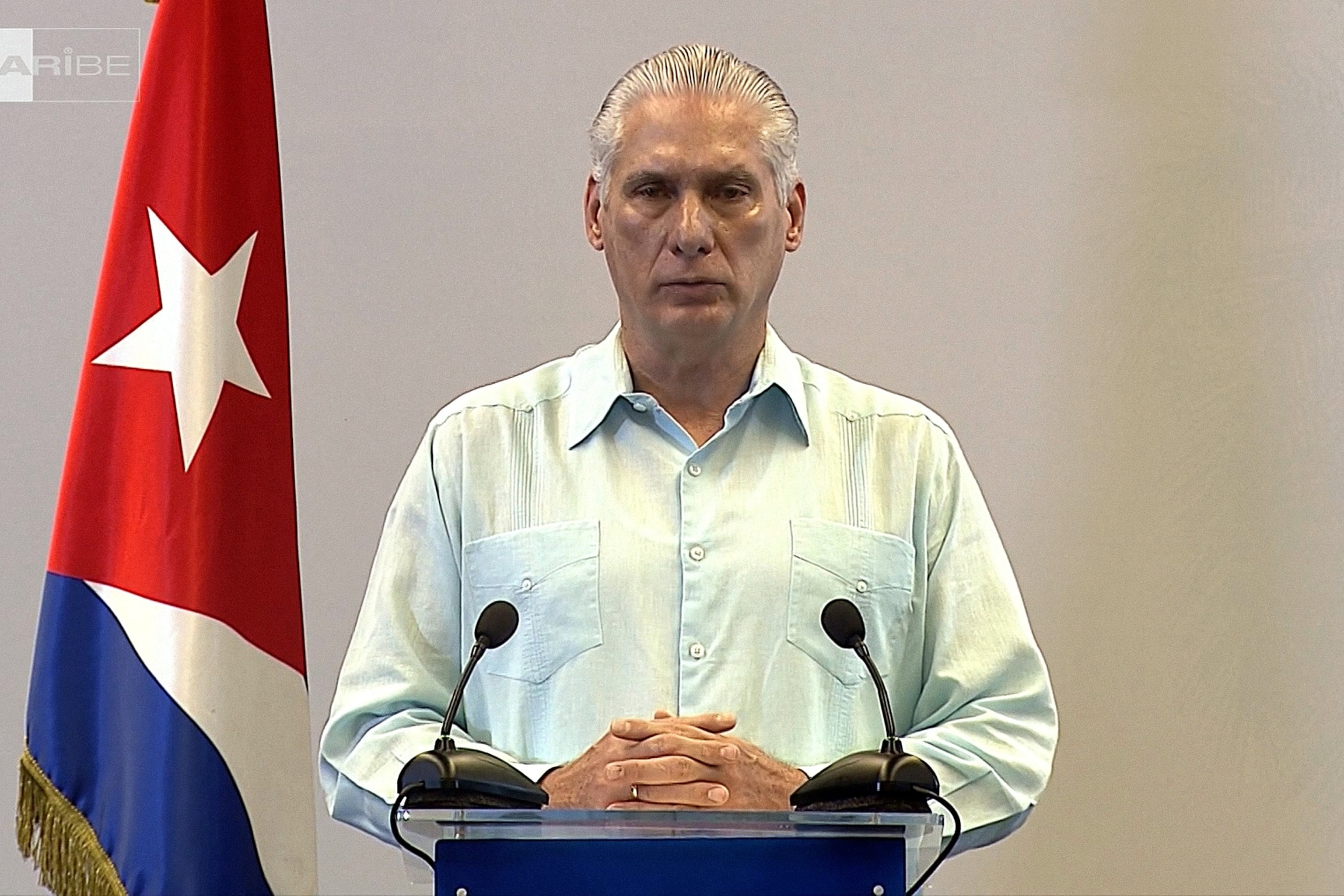
In this screen grab from footage broadcast by Cuban official TV on March 13, 2026, Cuba’s President Miguel Diaz-Canel speaks during a meeting with the communist-governed island’s top authorities in Havana. President Miguel Diaz-Canel said on March 13 that Cuban and US officials recently held talks as President Donald Trump’s administration piles pressure on the communist island.
CUBA TV via AFP via Getty Images
The White House has provided few specifics on the state of negotiations with Cuba, but President Trump indicated earlier this month he had charged Secretary of State Marco Rubio with leading the discussions and predicted Cuba was “going to fall pretty soon.”
“They want to make a deal so badly,” the president said in a phone interview with CNN. “They want to make a deal, and so I’m going to put Marco [Rubio] over there and we’ll see how that works out.”
Rubio and his top aides meet with representatives of the Cuban government at least half a dozen times in recent months, officials familiar with the conversations tell ABC News.
Little is known about the contours of any potential deal, but both the president and seasoned diplomats who have worked closely with Cuba for years have signaled they expect to see the regime collapse.
Their strategy for accomplishing that is also unclear; Trump has said there could be a “friendly takeover” of the country, but he also not taken military intervention off the table.

President Donald Trump attends a Women’s History Month event at the White House in Washington, March 12, 2026.
Will Oliver/EPA/Shutterstock
However, Rubio has indicated the administration might be willing to accept an incremental transformation of Cuba.
“Cuba needs to change. It needs to change. And it doesn’t have to change all at once. It doesn’t have to change from one day to the next. Everyone is mature and realistic here,” he said during a press availability in February.
Ted Piccone, a nonresident senior fellow in the Strobe Talbott Center for Security, Strategy, and Technology in the Foreign Policy program at Brookings, says that even among hardliners advocating for regime change in Cuba, there’s an appetite for stability.
“I think some in that community want something that’s more managed — not a total collapse and breakdown,” he said. “So I think this is going to be a more gradual process.”
Piccone also predicts that Cuba’s energy crisis could be mitigated, giving negotiations time to play out, if the Trump administration can establish a pathway to deliver fuel to Cuba’s private sector — cutting out its government.
Lee Schlenker, a research associate with the Global South program at the Quincy Institute for Responsible Statecraft, argues that the keys to success could be more time and a time-tested mediator.
The Vatican has served as a go-between for the U.S. and Cuba for decades. Recent talks between the Holy See and Havana led to Cuba agreeing to the release of 51 political prisoners.
“I think we’re ready for a radical shift, and the best way to get there is through is through a Vatican mediated effort to gradually build trust and confidence, to have verifiable and concrete guarantees for both sides and to not use the population as fodder that gets caught in the middle of dispute between the two governments,” Schlenker said.