The “K-shaped” economy is hitting U.S. consumers in unexpected ways, including their tax refunds.
Higher-income Americans are set to reap bigger benefits in their tax refunds than other households, thanks to changes in the “big, beautiful bill” act,” according to a recent analysis from investment firm Principal Asset Management. The Republican-backed measure, signed into law by President Trump in July of 2025, extended 2017 tax cuts and introduced a host of new tax breaks.
Experts have taken to describe the U.S. economy as K-shaped to reflect the trend in which wealthier Americans have pulled further ahead of lower-income workers amid a surging stock market and rising home prices.
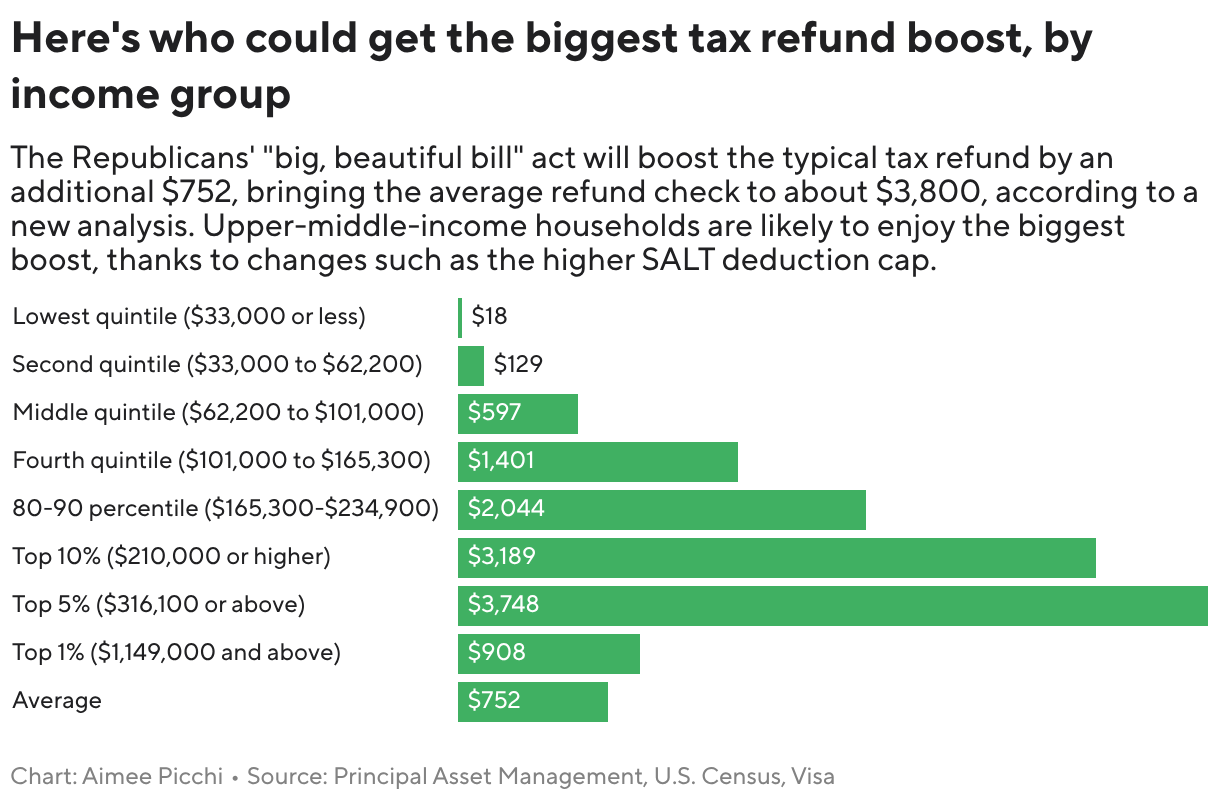
That pattern is also likely to be visible in this year’s tax refunds, which are expected to rise overall while delivering the biggest gains to upper-middle-income households, Principal Asset Management found.
“The average taxpayer’s cash refund should see a boost of over $700 this year, lifting the typical refund to around $3,800, fueled by retroactive provisions included in the One Big Beautiful Bill Act,” Principal Asset Management market strategist Christian Floro said in a recent report, noting that “these benefits are skewed toward higher-income households.”
The highest-income households, those in the top 1%, won’t benefit as much as those in the top 10% or 5%, largely because the income thresholds in the “big, beautiful bill” act phase out some tax deductions for top earners.
For instance, the new law boosts the state and local tax, or SALT, deduction cap to $40,000 for the current tax year, up from its prior $10,000 limit. But that deduction begins to phase out for taxpayers earning more than $500,000, meaning those in the top 1% — households with incomes above about $1.15 million — will not be able to claim it.
The top 1% of earners will see their tax refunds rise by an average of $908 this year, Principal found. That is about one-quarter of the additional $3,748 that households in the top 5% are expected to receive from the IRS.
The lowest earners — those who earn $33,000 or less — will see their refund checks increase by an average of $18 this year, according to Floro’s analysis.
The disparity in 2026 refunds “will likely exacerbate the already widening ‘K-shaped’ divergence across consumers,” he wrote. “Indeed, lower-income consumers are facing an affordability challenge amid still-elevated inflation, a softening labor market and limited participation in the positive wealth effects from the rising stock market.”
Still, some lower-earning households could see juicier refunds this year, depending on whether they can claim any new tax breaks, Bank of America Institute said in a January report. Some, such as workers in the hospitality industry, could benefit from the tax bill’s deductions for tips and overtime, it noted.