NEWYou can now listen to Fox News articles!
British Prime Minister Keir Starmer announced Tuesday that the United Kingdom is sending a warship and two Royal Navy Wildcat helicopters to Cyprus after an Iranian drone hit the British Royal Air Force (RAF) base of Akrotiri Monday morning on the east Mediterranean island.
In a social media post, Starmer said he spoke with the president of Cyprus, and the U.K. is deploying helicopters with counter-drone capabilities and the air-defense destroyer HMS Dragon to the region.
“The UK is fully committed to the security of Cyprus and British military personnel based there,” he wrote in the post. “We’re continuing our defensive operations… We will always act in the interest of the UK and our allies.”
The strike, which came days after Starmer reaffirmed his country was not involved in the conflict, hit a runway at the air base just after midnight Monday morning.
The HMS Dragon moored in the Royal Navy Dockyard on Oct. 28, 2024, in Portsmouth, England. Keir Starmer confirmed Tuesday, March 3, 2026, that the Dragon will be deployed to Cyprus. (Matt Cardy/Getty Images)
While there were no injuries, minor damage was reported.
British Defense Secretary John Healey said the country is “moving quickly” to further reinforce its defensive presence in the Eastern Mediterranean.
“HMS Dragon brings world-class air defence capability, and our Wildcat helicopters are armed with Martlet missiles to counter the growing drone threat,” Healey wrote in a statement. “I am deeply proud of the professionalism and bravery of our Armed Forces personnel who have, in recent days, successfully taken action across the region to protect our allies and defend British interests.”
The HMS Dragon, a type 45 destroyer, will strengthen the U.K.’s ability to detect, track and destroy aerial threats — including drones.
The ship is fitted with the world-leading Sea Viper missile system, which can launch eight missiles in under 10 seconds and guide up to 16 missiles simultaneously.
The deployment comes as the British armed forces successfully shot down multiple drones across the region over the last 24 hours.
RAF F-35B jets shot down drones over Jordan — the first time an RAF F-35 has destroyed a target on operations — supported by Typhoon jets and a Voyager tanker aircraft.
A British counter-drone unit neutralized drones in Iraqi airspace heading toward coalition forces, while an RAF Typhoon operating with the joint U.K.-Qatar 12 Squadron shot down an Iranian one-way attack drone directed at Qatar using an air-to-air missile on Monday.
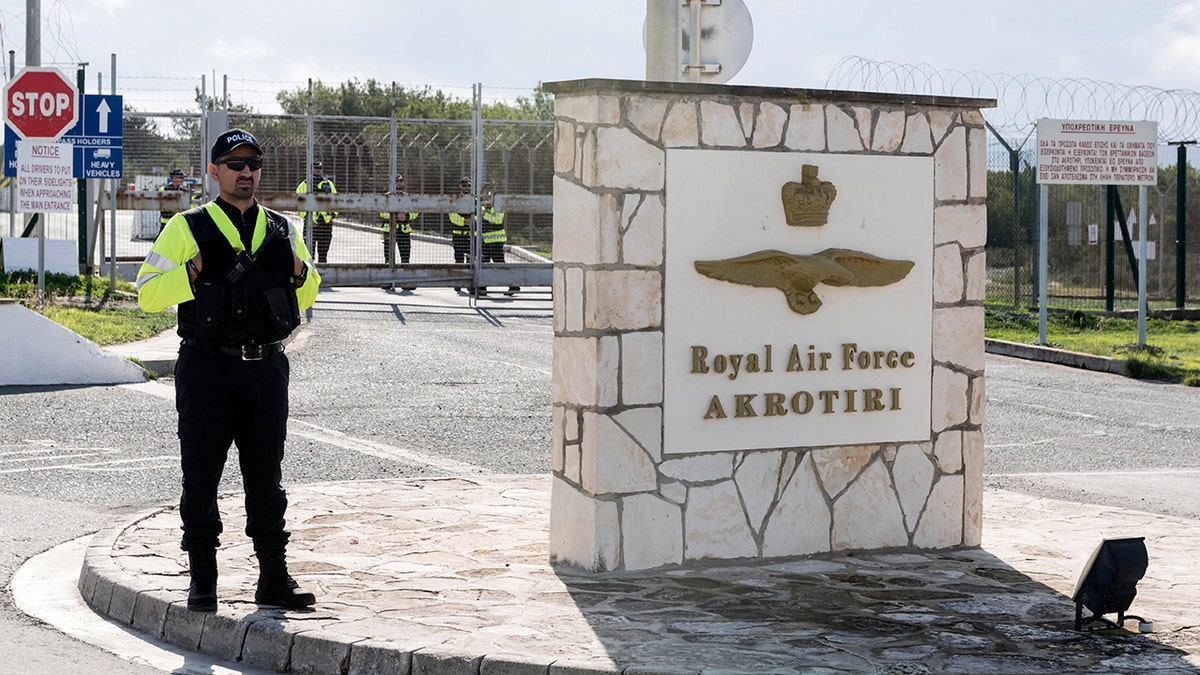
Police officers stand guard outside RAF Akrotiri base on Jan. 14, 2024, near Limassol, Cyprus. An Iranian-made drone hit the base on Monday, March 2, 2026, causing minimal damage and no injuries amid heightened tensions. (Iakovos Hatzistavrou/AFP via Getty Images)
Prior to the strike in Cyprus, Starmer released a video explaining that Iran launched sustained attacks across the region, on countries that did not attack them.
“They’ve hit airports and hotels where British citizens are staying. This is clearly a dangerous situation,” Starmer said. “We have at least 200,000 British citizens in the region. Residents, families on holiday and those in transit. I ask all our people in the region to please register your presence. And follow foreign office travel advice. I know this is a deeply worrying time, and we will continue to do all we can to support you.”
GULF STATES CONDEMN IRANIAN RETALIATORY STRIKES ON THEIR TERRITORIES FOLLOWING US-ISRAELI OPERATION
He added that the British armed forces are also “at risk,” noting Iran hit a military base Saturday in Bahrain, “narrowly missing British personnel.”
“The death of the supreme leader will not stop Iran from launching these strikes,” Starmer said. “Their approach is becoming even more reckless and more dangerous to civilians. Our decision that the U.K. would not be involved with the strikes on Iran was deliberate. Not least because we believe that the best way forward for the region and for the world is a negotiated settlement — one in which Iran agrees to give up any aspirations to develop a nuclear weapon — but Iran is striking British interests nonetheless, and putting British people at huge risk, along with our allies across the region. That is the situation we face today.”
He said partners in the Gulf asked them to “do more” to defend them, prompting a decision to allow the U.S. to use British air bases for targeted strikes against Iranian missile launchers and storage depots.
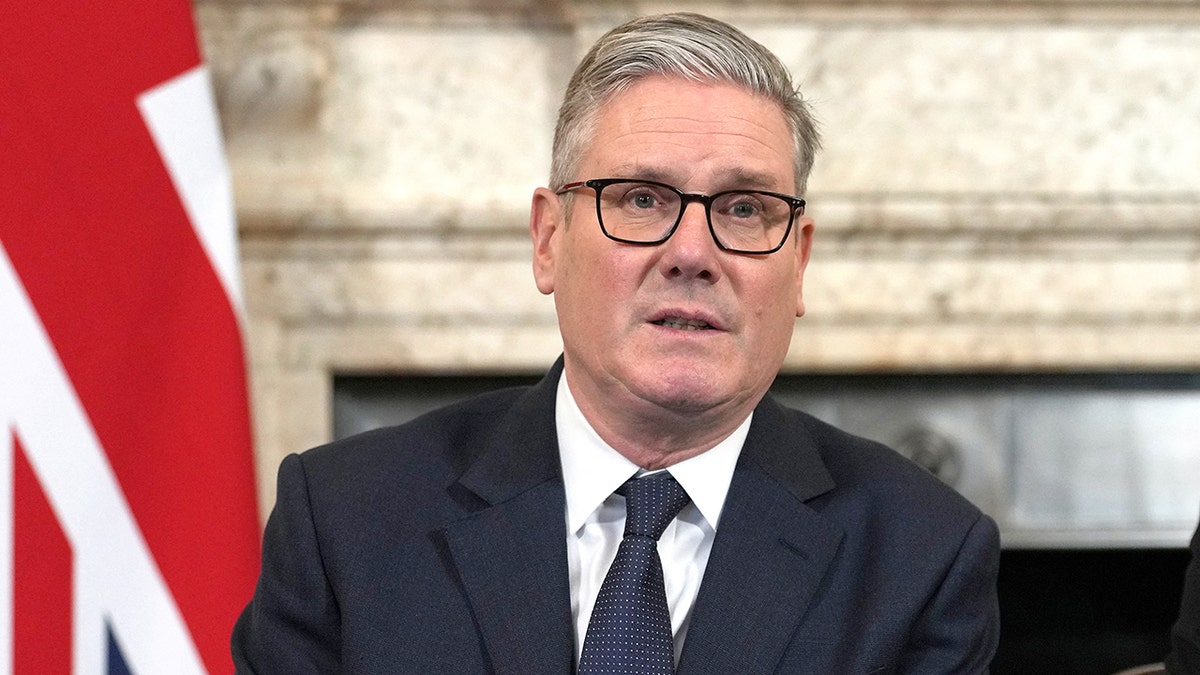
Britain’s Prime Minister Keir Starmer amped up the military presence in Cyprus following an Iranian drone strike early Monday. (Kin Cheung/Pool/AFP via Getty Images)
CLICK HERE TO DOWNLOAD THE FOX NEWS APP
“We have British jets in the air as part of coordinated defensive operations, which have already successfully intercepted Iranian strikes. But the only way to stop the threat is to destroy the missiles at source — in their storage depots or the launchers which are used to fire the missiles,” Starmer said. “The basis of our decision is the collective self-defense of long-standing friends and allies, and protecting British lives… We are not joining these strikes, but we will continue with our defensive actions in the region.”
“I want to be very clear: We all remember the mistakes of Iraq, and we have learned those lessons,” he continued. “We were not involved in the initial strikes on Iran, and we will not join offensive action now. But Iran is pursuing a scorched earth strategy. So we are supporting the collective self-defense of our allies and our people in the region because that is our duty to the British people. It is the best way to eliminate the urgent threat and prevent the situation spiraling further. This is the British government protecting British interests and British lives.”
The Associated Press contributed to this report.
Related Article